

 Tiếng Việt
Explore with Thomore
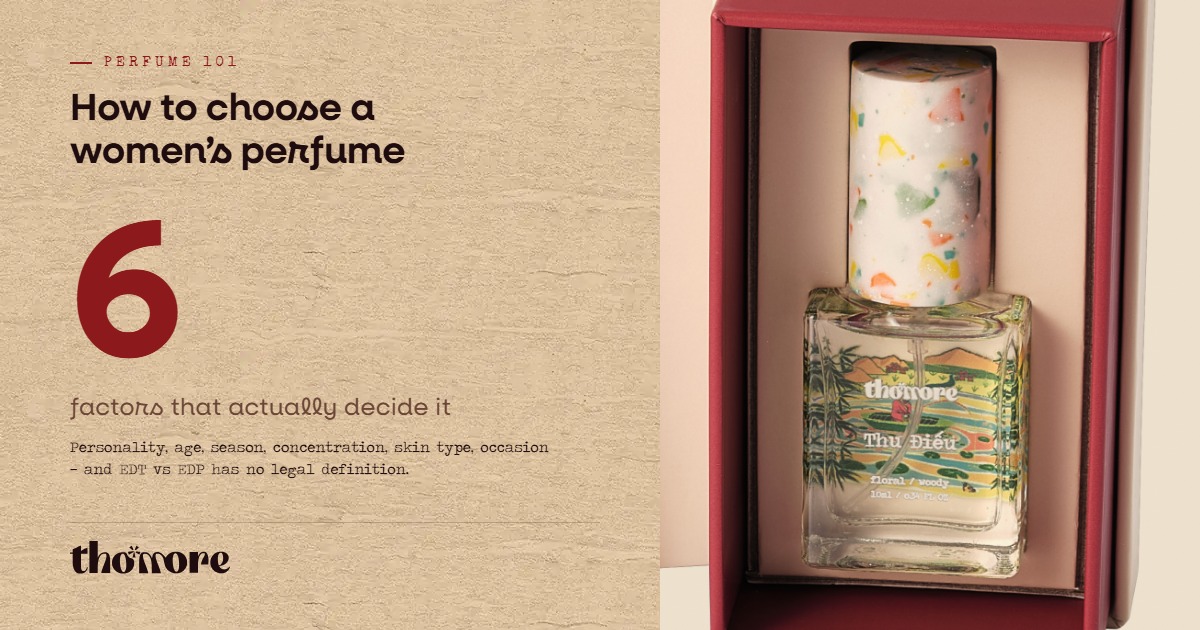
How to Choose a Women’s Perfume: Six Factors That Actually Decide It
Aug
Choosing a perfume is less about finding a pleasant smell than about finding one that behaves well on you, in the places you actually wear it. Six factors do most of the work — and the order in which you apply them matters more than any single recommendation.
Quick Summary
- Six axes decide the choice: personality, age, season, concentration, skin type and occasion. None of them works alone.
- Test on skin, never on paper. Wait 20–30 minutes so the scent passes through top, heart and base — the base is what you will actually wear.
- Skin type changes the result more than most people expect. Oily skin holds scent longer; dry skin releases it faster and benefits from moisturising first.
- Match concentration to the weather. Heat pushes fragrance outward, so lighter EDT and EDC suit hot days; EDP and Parfum come into their own in the cold.
- Do not test many scents at once. Your sense of smell saturates within a few tries and stops distinguishing anything useful.
I. Start With Occasion, Not With Personality
Most guides open with personality. In practice, occasion is the stronger filter, because it rules out whole categories quickly. A scent that is wonderful at dinner can be intrusive in a shared office or a car.
- Work and the office: green tea, white musk, soft florals — present without imposing.
- Daytime and activity: mint, bergamot, cucumber, citrus — clean and easy in heat.
- Evenings and occasions: amber, incense, oriental florals — where depth and projection are the point.
- Friends and family: powdery, light florals and soft fruit — approachable and familiar.
II. Then Narrow by Character
- Soft and romantic: fresh florals and gentle fruit — peony, jasmine, pear, peach.
- Bright and energetic: citrus — orange, mandarin, grapefruit, Italian lemon.
- Warm and magnetic: vanilla, sandalwood, amber, musk; these last longest and read best at night.
- Independent and distinctive: incense, leather, cedar, resins — less common, more memorable.
III. Concentration: What the Label Does and Does Not Tell You
Here is the part most guides state too confidently. There is no legal definition of “eau de toilette” or “eau de parfum.” No regulation in the EU or the US sets how much aromatic oil an EDP must contain, or how it must differ from an EDT. These are commercial conventions, and each house sets its own.
Industry guidance describes typical ranges — roughly 5–15% for EDT and 10–20% for EDP — but they are conventions, not standards. It is also worth knowing that IFRA’s published limits are safety ceilings by product category, not measures of strength or quality; they are frequently misquoted as though they regulated concentration.
The practical consequence: two bottles both labelled EDP, from two houses, can differ noticeably. Trust what the scent does on your skin over what the label claims.
As a rule of thumb, lighter concentrations suit hot and humid days, when body heat already pushes the scent outward. Heavier ones suit cool weather, where fragrance lifts more slowly.
IV. Skin Type Changes the Outcome
- Oily skin holds fragrance longer, so an EDP is usually enough. Citrus and herbal notes stay fresh rather than turning heavy.
- Dry skin loses scent faster. Moisturise before applying and lean towards warm notes — vanilla, soft woods — which cling better.
- Sensitive skin: avoid spraying directly. Apply to hair or clothing, and prefer gentler formulations without harsh aromatics.
V. How to Test Properly
- Decide what you want the scent to say before you smell anything — it narrows the field fast.
- Spray on the wrist and wait 20–30 minutes. The opening is not the fragrance.
- Limit yourself to two or three scents per visit. Beyond that, your nose stops giving you reliable information.
- Where possible, live with a sample for a day before committing to a full bottle.
VI. Three Thomore Fragrances for Women
| Fragrance | Note structure | Concentration | Longevity | Projection | Suits |
|---|---|---|---|---|---|
| Đây Thôn Vĩ Dạ | Jasmine, May rose – mimosa, Australian laurel, raspberry – sandalwood, vanilla, musk | EDP | 8–12 hours | Within 2m | Feminine with a contemplative depth; classic and romantic |
| Kiều | Strawberry, raspberry – peony, rose, berries – soft woods, white musk | EDP | 8–12 hours | Within 2m | Clear and modern, with an East Asian sensibility |
| Bánh Trôi Nước | Raspberry, pear, pomelo – apple blossom, violet, lychee, jasmine – plum, sandalwood, musk | EDP | 8–12 hours | Within 2m | Gentle, fresh and approachable |
VII. Frequently Asked Questions (FAQ)
1. Which concentration should a beginner start with?
Start with an Eau de Toilette for daytime and warm weather — it is lighter and more forgiving while you are still learning what you like. Move to Eau de Parfum once you know which families suit you and want longer wear.
2. How much more oil does an EDP contain than an EDT?
There is no fixed figure, because no law defines either term — they are commercial conventions and each house sets its own. Typical ranges are around 5–15% for EDT and 10–20% for EDP, but two bottles both labelled EDP can differ noticeably in strength. Judge by how the scent performs on your skin rather than by the label.
3. How long should I test a fragrance before buying it?
About 20–30 minutes after spraying on the wrist, so it passes through the top and heart notes into the base. The scent in the first minute bears little resemblance to what you will wear all day.
4. Does dry skin hold perfume less well than oily skin?
Yes. Oily skin retains fragrance longer, so a standard EDP is usually sufficient. On dry skin the scent fades faster, so moisturise beforehand and favour warm notes such as vanilla or soft woods, which last better.
5. How many fragrances should I try in one session?
Two or three at most. Testing several in quick succession saturates your sense of smell, after which you can no longer tell which one genuinely suits you.
6. Can sensitive skin wear perfume?
Yes, but avoid spraying directly onto skin. Apply to hair or clothing instead, and choose gentler formulations without strong aromatics or high alcohol content.
 Tiếp tục với Zalo