

 Tiếng Việt
Explore with Thomore
Woody Perfumes for Men: 5 Wood Notes and 5 Bottles to Know
Aug
Woody fragrance is the default choice for a lot of men, and for good reason: it is polished, it reads as expensive, and it fits almost any setting. This guide from Thơmore covers the five wood families, five bottles worth knowing, and how to pick one that matches your character — plus how to store and wear it so you get everything out of it.
Quick Summary
- Wood mostly lives in the base notes, where it holds the longest and gives the whole composition its depth — it is not what you smell first.
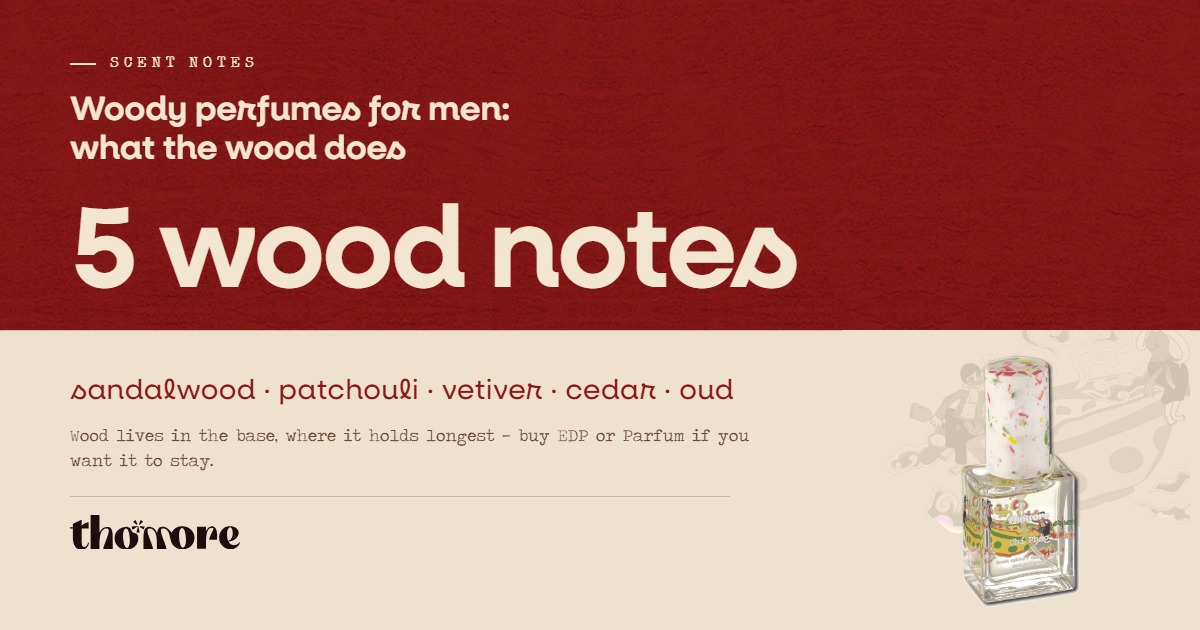
- The five common wood families feel very different: sandalwood is sweet and creamy, patchouli is damp earth with a little spice, vetiver is smoky and faintly bitter, cedarwood is dry and clean, oud is rich and deep.
- Most woody fragrances use reconstituted materials — natural sandalwood and oud have become scarce and expensive.
- If you want the wood to hold, buy the concentration. EDP or Parfum keep the base notes going far better than lighter formats.
Woody fragrance for men, in short
Woody fragrance for men reads as warm, confident and precise — the register of someone settled in their own style. The family leans on materials such as sandalwood, cedarwood, patchouli and oud, which give it depth and pull. These fragrances suit a wide range of characters, from the assertive and mysterious to the open and easy-going, and they leave an impression that lasts.
Woody scents get the most wear in autumn and winter, when their warmth is most welcome. They work almost anywhere, from the office to a dinner to an afternoon walking around town. And with the range they cover — warm woods, smoky woods, fresh woods — each bottle is its own experience.
| Wood family | How it smells | What it conveys |
|---|---|---|
| Sandalwood | Sweet, creamy, warm, smooth as milk | Luxurious, calming |
| Patchouli | Damp earth, moss, lightly spicy | Mysterious, assertive |
| Vetiver | Smoke, dry earth, a bitterness like dark chocolate | Refined, mature |
| Cedarwood | Dry, clean, faintly spicy | Balanced, precise |
| Oud | Rich, sweet, deep | Luxurious, commanding |
The five wood families
Wood is what gives a men’s fragrance depth and backbone. It usually sits in the base, where it holds the scent together and keeps it interesting hours in. These are the woods you will meet most often in perfumery.
1. Sandalwood
Sandalwood is sweet, warm and smooth as milk, and it makes a men’s fragrance feel both luxurious and calming. Most houses now use reconstituted sandalwood, because the natural source has become scarce.
- Origin: southern India and Southeast Asia.
- Character: softly sweet, warm, slightly milky.
- Pairs well with: lavender, bergamot, black pepper.
2. Patchouli
Patchouli brings damp earth, moss and a little spice, which is what makes a men’s fragrance read as mysterious and assertive. It was the signature of the hippie movement in the 1970s and it remains a favourite in niche perfumery.
- Origin: India, China.
- Character: damp earth, oakmoss, black pepper.
- Pairs well with: rose, lavender, vetiver.
3. Vetiver
Vetiver gives smoke, dry earth and a bitterness reminiscent of dark chocolate, which lends a men’s fragrance its refinement and maturity. Haitian vetiver is the most highly regarded, for the quality of its oil.
- Origin: Haiti, Java, India, China.
- Character: smoke, earth, dry wood, a light bitterness.
- Pairs well with: amber, leather, oud.
4. Cedarwood
Cedarwood is dry, clean and faintly spicy, and it keeps a men’s fragrance balanced and precise. It is often treated as a “clean base note” that fixes the other materials in place.
- Origin: the Himalayas, the Mediterranean.
- Character: dry warmth, light spice, something like a freshly sharpened pencil.
- Pairs well with: musk, lavender, sandalwood.
5. Oud
Oud is rich, sweet and deep, and it is what makes a men’s fragrance feel luxurious and commanding. Because natural oud is rare and expensive, many houses now use a reconstituted version.
- Origin: Southeast Asia (Laos, Cambodia, Vietnam).
- Character: powerful, sweet, deeply warm.
- Pairs well with: rose, amber, spices.
Five woody fragrances for men worth knowing
Woody men’s fragrances hold their following because they are confident, polished and easy to wear across occasions. Among the most admired:
Chanel Bleu de Chanel EDP
Bleu de Chanel is one of the defining modern men’s fragrances. It launched in 2010 and effectively created the “blue fragrance” category; the EDP arrived in 2014, warmer, deeper and more finished than the original, which makes it both polished and compelling across very different settings.
Notes:
- Top: grapefruit, mint, lemon, pink pepper, aldehydes, bergamot, coriander seed
- Heart: ginger, melon, jasmine, nutmeg
- Base: incense, amber resin, cedarwood, sandalwood, patchouli, labdanum
Longevity: 6–8 hours
Projection: 1–2 metres — enough presence without becoming sharp
Reference price: 3,250,000 VND / 50ml
Diptyque Tam Dao
A standout unisex woody fragrance built on the stillness of Asian forests. Diptyque launched the EDT in 2003, soft and clear; the EDP followed in 2013, more concentrated and considerably deeper. The bottle is a clear oval glass with a black cap, evoking something quiet and old amid green surroundings.
Notes:
- Top: rose, Italian cypress, myrtle
- Heart: cedarwood, sandalwood
- Base: spices, white musk, Brazilian rosewood, amber
Longevity: 6–8 hours
Projection: around 1 metre — discreet and precise
Reference price: 4,550,000 VND / 75ml
Tom Ford Oud Wood
Released in 2007 as part of the Private Blend collection, Tom Ford Oud Wood became the reference point for luxurious oud-based fragrance. It sets rare oud against warm spice and a soft sweetness of vanilla — mysterious and seductive at once.
- Top: Brazilian rosewood, agarwood (oud)
- Heart: cardamom, vetiver, tonka bean, sandalwood, black pepper
- Base: amber, vanilla
Longevity: 6–8 hours
Projection: moderate — compelling without being overbearing
Reference price: 5,450,000 VND / 100ml
Hugo Boss Bottled EDT
Composed in 1998 by Annick Menardo, Hugo Boss Bottled EDT quickly became shorthand for the modern man: polished, self-assured, energetic. Fresh with a warm sweetness underneath, it is stylish and easy to wear every day.
Notes:
- Top: plum, apple, lemon, bergamot, oakmoss, geranium
- Heart: mahogany, cinnamon, carnation
- Base: sandalwood, cedar, vetiver, vanilla, olive
Longevity: 6–8 hours, steady through a long day
Projection: moderate — present and comfortable, never overpowering
Reference price: 1,050,000 VND / 100ml
Le Labo Santal 33 EDP
Launched in 2011, Le Labo Santal 33 became a unisex landmark on the strength of its warm, precise woods. Inspired by the American West and its long train journeys, it feels free and assertive while keeping something soft and magnetic underneath.
Notes:
- Top: Virginia cedarwood, sandalwood
- Heart: violet, cardamom, papyrus
- Base: leather, iris, amber
Longevity: long — 9–12 hours
Projection: carries well, and leaves a lasting impression
Reference price: 5,650,000 VND / 100ml
Alongside the established houses, Thơmore’s own woody fragrances for men are worth considering — assertive and masculine but still precise, and at home on an ordinary day as much as a particular occasion.
How to choose a woody fragrance that suits you
Woody fragrance appeals to a lot of men because it is confident, compelling and easy to wear. Choosing the right one, though, means weighing your own taste, how you live, and where you actually spend your time.
1. Work out which wood family you like
Each family carries its own register:
- Warm woods: sandalwood, cedarwood and patchouli give you something luxurious and warm.
- Smoky woods: guaiac wood and oud bring strength and mystery, for when you want to make a deeper impression.
- Fresh woods: vetiver and cypress feel clear and comfortable, which suits hot weather particularly well.
2. Choose for your style
- Sandalwood, amber and cedar suit a polished, grown-up style.
- Oud, leather and smoky woods suit something stronger and more distinctive.
- Fresh woods with citrus read as open and free.
- Amber, black pepper and burnt wood bring out something mysterious and seductive.
- Fresh woods with light spice suit a younger, more energetic style.
3. Mind the longevity and the projection
Two practical things to weigh:
- If you want the scent to hold, Eau de Parfum (EDP) or Parfum will serve you better, being more concentrated.
- If you prefer something lighter that never dominates, Eau de Toilette (EDT) is the safer choice.
4. Test before you buy
Try the fragrance on your own skin — skin chemistry differs, and a scent changes over the hours. Give it at least a few hours so you experience all three layers. A useful trick is to buy a small size or a mini first, before committing to a full bottle.
Storing and wearing it well
To keep a woody fragrance in condition, a few simple habits matter:
- Close the cap after use, so air does not oxidise the perfume.
- Keep it out of direct light and away from heat, both of which alter the scent.
- Store it somewhere dry and cool, which keeps the structure stable and extends the life of the bottle.
And to get the most out of it when you wear it:
- Apply to pulse points — wrists, behind the ears, the nape, the chest — so the scent diffuses naturally.
- Hold the bottle 15–20cm away and use just enough for an even application.
- Do not rub the skin afterwards: it breaks the structure of the layers and makes the scent fade faster.
Why sandalwood and oud keep getting scarcer
This guide has mentioned more than once that houses tend to use reconstituted materials rather than natural sources. Here is what sits behind that.
Indian sandalwood (Santalum album) is classified as vulnerable on the IUCN Red List, as a result of over-harvesting. India has imposed an export ban to protect the species, and the striking consequence is that the country that once supplied the world’s finest sandalwood is now a net importer, buying oil from plantations in Australia.
The oil concentrates in the heartwood and roots, and only reaches quality once the tree has matured over many years — this is a raw material measured in decades, not seasons. Put those three things together and the cost lands somewhere a mainstream bottle simply cannot carry.
What does that mean when you are choosing a woody fragrance? A mainstream bottle listing “sandalwood” is almost certainly using a reconstituted material rather than pure oil. That is not dishonesty — with real oil, the bottle would sit in an entirely different price bracket. Reconstituted materials also take pressure off a species already in decline.
Related reading:
- What does musk smell like, and why is it everywhere in perfume?
- Baby powder perfume: what it is and five to try
Choosing a woody fragrance for men well comes down to your taste, where you wear it and the style you want to project. Store it properly and apply it properly, and it will give you everything it was built to give.
Frequently Asked Questions
1. Is woody fragrance only for cold weather?
No. The dry woods — cedarwood and vetiver — wear well all year, including in hot and humid climates. The warmer, richer end of the family, oud especially, comes into its own when the weather turns cool.
2. What is the difference between sandalwood and oud?
Sandalwood is sweet, warm and smooth as milk, and it reads as calming. Oud is rich, deep and considerably more powerful, and it tends to convey luxury and authority.
3. Why do so many woody fragrances use reconstituted materials?
Because the natural sources keep getting scarcer. Indian sandalwood is classified as vulnerable on the IUCN Red List and India has banned its export; natural oud is also rare and expensive. Reconstituted materials keep the character of the scent at a price people can reach, and they take pressure off a species already in decline.
4. How do you make a woody scent hold longer on skin?
Buy the concentration — EDP or Parfum hold the base notes better than lighter formats. Applying to well-moisturised skin also helps the molecules hold, compared with dry skin.
 Tiếp tục với Zalo