

 Tiếng Việt
Explore with Thomore
EDP vs EDT: What the Label Really Says About How a Perfume Wears
Jun
On a perfume bottle, letters like EDP or EDT aren’t just names — they tell you the oil ratio in the formula and directly shape how the scent behaves on your skin. This article explains the real difference between the two formats, and why actual longevity usually depends on more than a single number on the label.
Quick Summary
- Eau de Parfum (EDP): Typically around 15%–20% aromatic oils, focused on the depth of the heart and base notes.
- Eau de Toilette (EDT): Typically around 5%–15% aromatic oils, prioritising a clear, projecting opening in the top notes.
- The real rule: Longevity isn’t perfectly proportional to the concentration on the label. The character of the note family, your skin chemistry, and the temperature and humidity around you affect the real experience more than the EDP-or-EDT figure.
I. The Common Perfume Concentration Levels
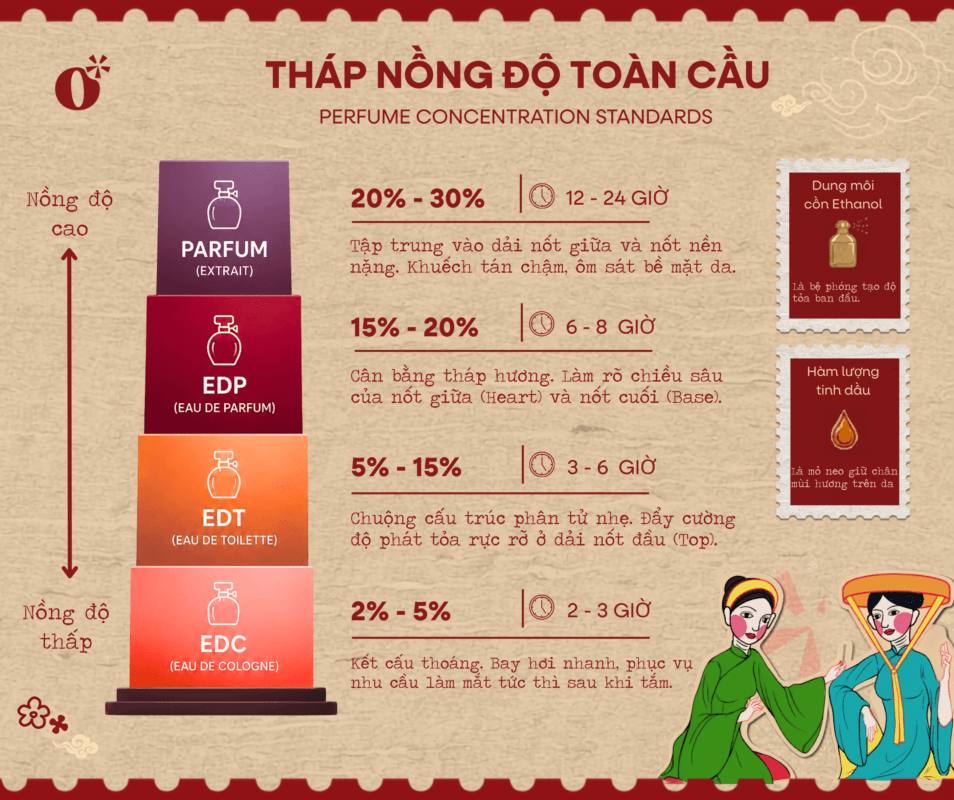
In perfumery, the letters on the bottle — Parfum, EDP, EDT or EDC — represent the ratio of aromatic oils dissolved in a solvent of ethanol and deionised water. The concentration system is commonly laid out in tiers as follows:
A standard reference table of concentration tiers
| Concentration level | Abbrev. | Oil ratio | Reference longevity* | Layering structure |
| Parfum / Extrait | P | 20%–30% | 12–24 hours | Focused on the heart and base. Slow diffusion, hugs the skin. |
| Eau de Parfum | EDP | 15%–20% | 6–8 hours | Balances the pyramid. Brings out the depth of the heart and base. |
| Eau de Toilette | EDT | 5%–15% | 3–6 hours | Pushes a clear, projecting opening in the top notes. |
| Eau de Cologne | EDC | 2%–5% | 2–3 hours | Airy texture. Evaporates fast, good for instant freshness. |
*The longevity in the table is a theoretical estimate under standard conditions. The real experience varies with the note family, your skin chemistry and where you wear it.
The alcohol solvent acts as a carrier, releasing the scent particles into the air. The higher alcohol content in an EDT helps the scent project quickly at the opening; the higher oil content in an EDP helps sustain the scent longer on skin. But this is only a starting point — not a guaranteed outcome.
II. What Is EDP?
EDP (Eau de Parfum) — a standard perfume concentration
- Common oil ratio: 15%–20%
- Structural character: Concentrates the scent particles in the heart and base notes. The scent moves steadily with depth, suiting everyday wear or cooler environments.
- Note: The EDP label doesn’t automatically guarantee longer wear than every EDT. The final result depends on the nature of the materials and the structure of the whole formula.
III. What Is EDT?
EDT (Eau de Toilette) — a standard perfume concentration
- Common oil ratio: 5%–15% dissolved in an alcohol solvent
- Structural character: Prioritises a clear release in the top notes. Airy, bright and light — suiting hot weather or everyday outdoor activity.
- Note: The EDT label does not mean lower quality or poorer materials than an EDP.
IV. Where Do EDP and EDT Differ?
1. Oil content
EDP holds roughly 5%–10% more oils than EDT in the overall formula.
2. How the scent projects
EDT projects clearly and fills the space well at the opening, thanks to its higher alcohol ratio. EDP narrows the initial projection, diffusing more calmly and holding a more persistent connection through the heart and base.
3. Real-world reapplication
An EDP often carries a long workday on a single application. With an EDT, wearers tend to reapply once or twice later in the day to refresh the scent.
4. Suitable spaces
EDT works well in tight spaces like a small office, a classroom or a car without overwhelming those nearby. EDP suits open spaces, large air-conditioned rooms or formal evenings.
V. Does EDP Always Last Longer Than EDT?
The straight answer: no.
EDP only indicates a higher oil ratio in the liquid — it doesn’t guarantee that every component lasts longer.
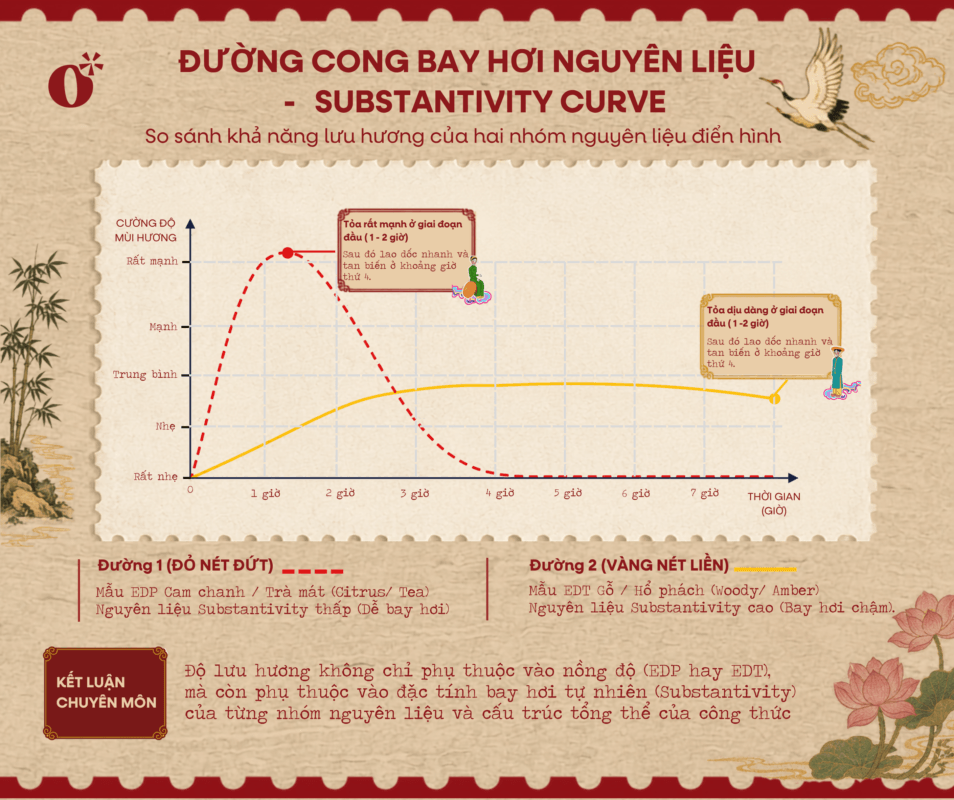
In perfumery, a fragrance’s ability to cling and persist on skin over time is measured by the concept of substantivity. This depends on the natural evaporation rate of each material family:
- Low substantivity (fast to evaporate): Citrus notes such as lemon oil and bergamot oil, green tea and light white flowers. A formula leaning citrus or tea, even in EDP format, can last shorter than expected.
- High substantivity (slow to evaporate): Woody and amber notes such as sandalwood, patchouli, cedarwood, ambroxan and musks. These cling to skin better and evaporate very slowly.
In many real cases, a woody or ambery EDT can cling to skin longer than a citrus-leaning EDP. This is why perfumers usually judge longevity from the whole formula — not just the EDP or EDT letters on the bottle.
A real comparison: Dior Sauvage EDT and EDP
To show the shift in performance between the two levels more clearly, compare the Dior Sauvage range worn on the same skin:
- Sauvage EDT: The formula pushes Calabrian bergamot in the top notes. The scent is bright, diffuses widely and projects strongly at the opening before settling.
- Sauvage EDP: The perfumer tempers the citrus, giving way to ambroxan and a warm vanilla range in the base. It doesn’t burst at the start but moves deeper and more persistently, staying clearly perceptible all day without a top-up.
VI. Why Do Different People Experience the Same Bottle Differently?
Two people wear the same product on the same spot yet get different longevity and scent character. This comes down to the interaction between the oils and each person’s biology.
1. Skin moisture and lipids
Perfume oils bind well with the skin’s natural fats (lipids). People with oily skin hold a scent longer because the sebum film acts as a natural fixative, slowing evaporation. People with dry skin, lacking that moist film, find the scent fades faster.
2. Body temperature
Skin temperature at the pulse points provides heat that drives the solvent to evaporate. People who run warmer often find the scent projects more widely at the opening, but the base notes may also finish sooner.
3. Skin pH
The range of skin pH varies between people and can contribute to differences in scent perception and how quickly the layers transition, though it isn’t the only factor deciding longevity. The combination of pH and each person’s particular sebum level reshapes how some scent particles evaporate over time.
4. Lifestyle and surroundings
Your activity level, how much you sweat, your clothing fabric and your workspace (enclosed or open) all affect how the scent molecules diffuse through the day.
VII. How Heat and Humidity Change a Scent
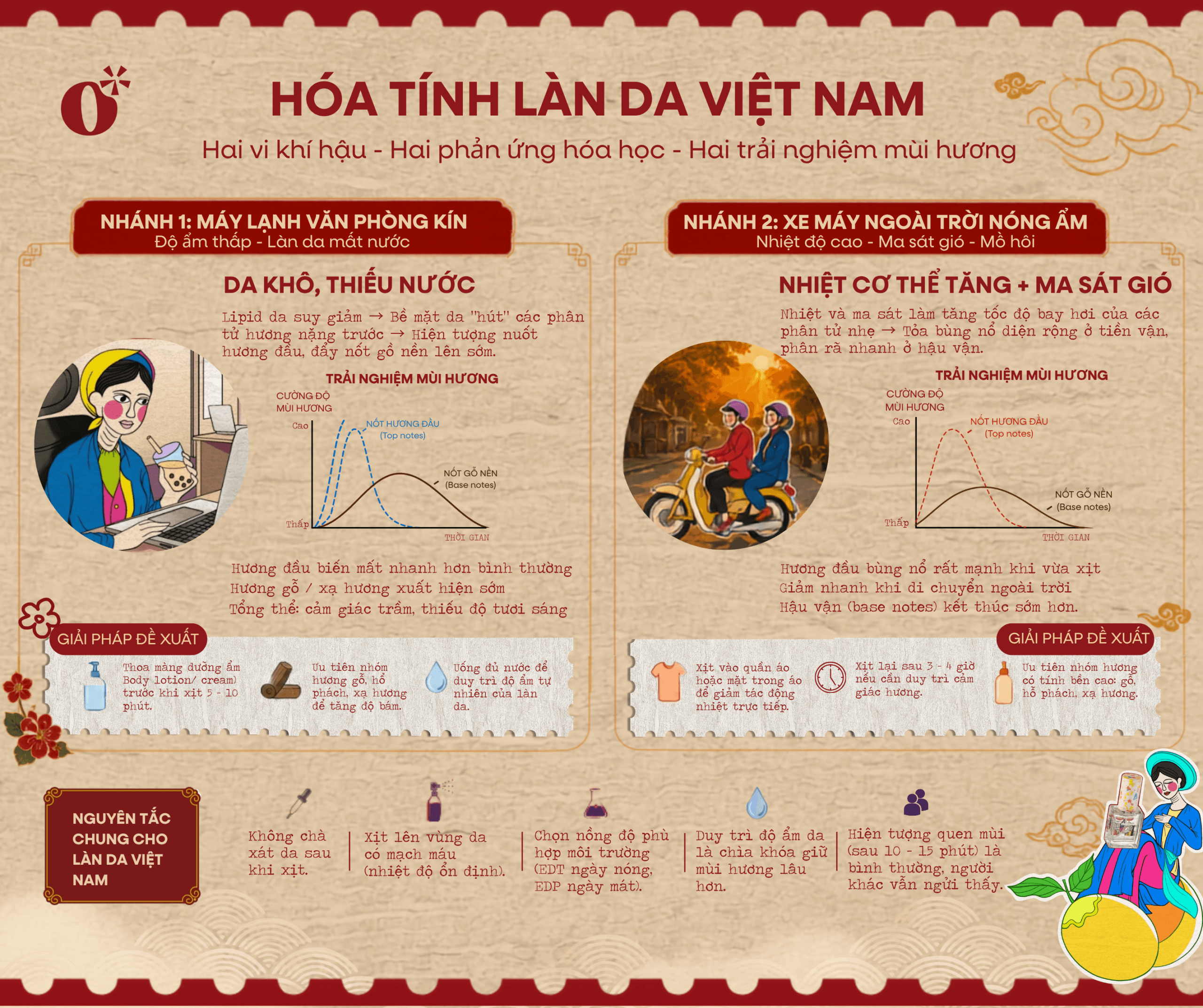
Hot, humid weather, shifting air moisture and particular commuting habits — the kind common across much of Southeast Asia, including Vietnam where Thơmore is based — noticeably change how a perfume behaves on skin.
Travelling outdoors in the heat
Rising skin temperature under the sun drives the alcohol solvent to evaporate harder. The top notes project clearly and diffuse more widely at the opening. Natural sweat, however, can change the transition pace, so the base notes may finish sooner than they would indoors.
Long hours in an air-conditioned office
Air conditioning is dehumidifying, lowering the skin’s natural moisture. As skin dries, oil particles tend to be absorbed faster. The top notes evaporate sooner, making way for the base to appear earlier than usual. Projection tends to narrow, hugging the skin after several hours.
Observations from consultations at Thơmore
Across many field observations and conversations with customers in hot, humid conditions, our team has noticed a few recurring patterns:
People who spend long hours in cold rooms often find the top notes drop faster because their skin loses moisture. Applying a thin layer of unscented moisturiser before spraying helps keep the pyramid more stable in that environment.
When commuting under the sun, woody and musk families tend to hold up better than citrus or green ones — because they’re less affected by heat and sweat.
Olfactory adaptation — when your nose dials down its perception of your own scent — happens more often in hot, humid climates. Wearers tend to over-apply, ending up too strong in enclosed spaces. If you can’t smell yourself after 20–30 minutes, the people around you usually still can — no need to add more.
VIII. Should a Beginner Choose EDP or EDT?
There’s no one-size-fits-all pick. It depends on your real needs and daily environment.
Consider EDP if: You need a scent that stays steady through a long day; you work mostly in cold rooms; or you like the warmth of woody and amber base notes.
Consider EDT if: You want a bright, light feel; you wear perfume by day in tight spaces; or you’re often on the move outdoors.
More important than the technical figures is testing directly on your skin — wait for the scent to dry down and settle before investing in a large bottle. Small formats or a discovery set are the safest way to check the real experience on your own skin.
A note from Thơmore
A perfume’s real performance is the result of four variables at once: oil concentration — note-family structure — the skin’s biology — and the climate where it’s worn. EDP or EDT is only one of those four.
Some of Thơmore’s EDP formulas are developed with a higher oil ratio than the market norm — 36%–40%, per our internal lab notes — to hold scent depth steadily in the hot, humid daily climate of Vietnam. The real experience still depends on each person’s skin and environment.
IX. Frequently Asked Questions (FAQ)
1. Does EDP always last longer than EDT?
Not absolutely. Longevity depends heavily on the substantivity of the material family. A woody or ambery EDT that evaporates slowly can sometimes cling to skin longer than an EDP leaning towards citrus or light tea.
2. Is EDT a good fit for a hot, humid climate?
Yes. EDT suits sweltering days, outdoor activity or tight office spaces — thanks to its airy, fresh feel and clear projection at the opening without turning heavy.
3. Why does the same perfume last longer on someone else than on me?
This comes down to differences in skin chemistry. Body temperature, how much you sweat and especially your skin’s moisture directly change the natural evaporation rate of a perfume.
4. Does oily or dry skin hold perfume longer?
Oily skin holds perfume longer. Oils bind well with natural fats — the lipid film on oily skin acts as a natural fixative, slowing the scent’s evaporation.
The information here is for reference. The real scent experience can vary with your skin chemistry, where you wear it and how each person perceives it.
About Thơmore
Thơmore is a Vietnamese perfume brand inspired by literature, developing scents that carry the spirit of memory, emotion and the cultural textures of everyday Vietnamese life.
Explore more at: Thơmore
 Tiếp tục với Zalo