

 Tiếng Việt
Explore with Thomore
Why a Scent Can Take You Back in Time in Seconds
Jun
How olfactory memory works, and how relationships are kept alive through scent
Perfume does more than smell good — because of the distinctive biology of the olfactory system, scent molecules can trigger memory and emotion, mark milestones and preserve the bond between people in just a few seconds.
QUICK SUMMARY
- The neural mechanism: The primary olfactory pathway connects directly to the limbic structures (including the hippocampus and amygdala) before passing through the brain’s higher processing centres.
- The Proust effect: An automatic olfactory reflex unlocks distant autobiographical memories, along with the original emotional state of the moment they were recorded.
- Building relational memory: Combining scent + ritual + the presence of a person creates olfactory memory artifacts, letting us preserve emotional data and meaningful milestones.
I. SMELL IS THE SENSE MOST STRONGLY TIED TO MEMORY
The human perceptual system handles five main senses, but smell runs along an entirely separate biological route.
When we take in signals from sight (images), hearing (sound), touch (contact) or taste, the nerve impulses must travel through a central relay in the brain called the thalamus. There the information is filtered, analysed and encoded before being sent to the cortex for recognition.
The primary olfactory pathway, by contrast, connects directly to the limbic structures before reaching the brain’s higher processing centres. When scent molecules enter the nasal cavity they stimulate the olfactory receptor cells directly, are converted into bioelectric signals, and travel straight to the brain regions responsible for emotion and memory. This is why scent triggers nostalgia faster and more deeply than the other senses.
II. WHY CAN A SCENT WAKE A MEMORY FASTER THAN AN IMAGE?
Scent can trigger memory more strongly and quickly than an image because the olfactory signal connects directly with two brain regions — the hippocampus and amygdala — that are closely tied to memory and emotion.
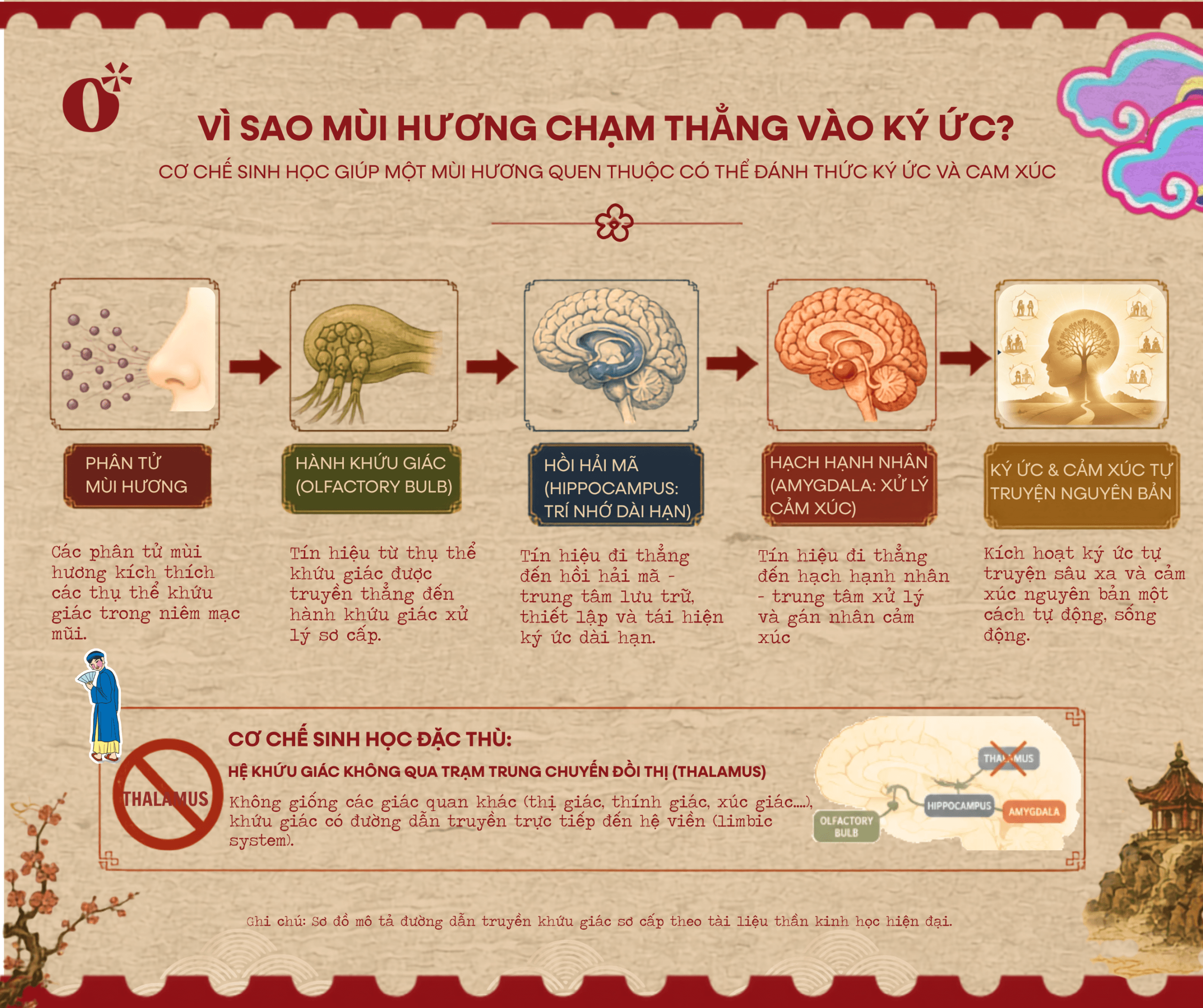
Olfactory information is processed through three closed biological anchors:
- Olfactory bulb: The first region to receive scent impulses, sitting just behind the nasal cavity, with a direct pathway to the neighbouring neural structures without interruption.
- Hippocampus: The brain structure central to storing, consolidating and retrieving long-term memories, especially autobiographical memory.
- Amygdala: The neural centre governing raw emotional responses, such as calm, sadness or joy.
Because the olfactory bulb shares a direct anatomical network with the hippocampus and amygdala, a single scent molecule instantly unlocks both the box holding the event (the memory) and the box holding its accompanying emotional state.
III. WHAT IS THE PROUST EFFECT?
The Proust effect
- Origin: Named after the French writer Marcel Proust, from the classic passage in In Search of Lost Time (À la recherche du temps perdu), in which the narrator smells a madeleine dipped in tea and his entire childhood springs vividly back to life.
- The scientific definition: The phenomenon where a scent automatically and unconsciously triggers distant autobiographical memories thought to be forgotten, along with an intense emotional charge.
How the Proust effect unfolds:
An unexpected encounter with a scent → stimulation of the nasal lining → the hippocampus is unlocked → autobiographical memory resurfaces → the original emotion arises
IV. THE MEMORIES WE KEEP BY ACCIDENT, THROUGH SCENT
In daily life, the brain automatically records unconscious memories through particular environmental cues and materials. These are nostalgic anchors that surface with no warning:
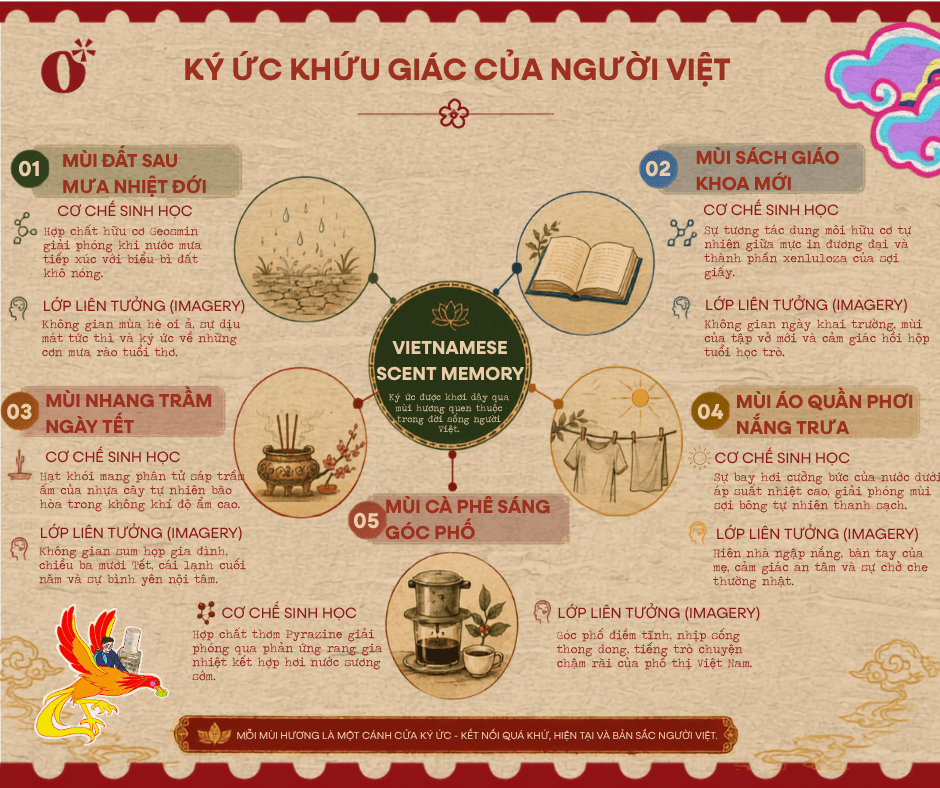
- The smell of earth after tropical rain: The release of the organic compound geosmin as rain hits hot, dry ground brings up that damp, earthy scent so characteristic of summer days.
- The smell of a new book: The interaction between printing-ink solvents and the cellulose of the paper creates a dry, faintly pungent scent that instantly pulls you back to the first day of a new school year.
- The smell of incense at Tết: The smoke carries the warm, resinous note of agarwood woven into the cold air at year’s end, evoking a sense of peace and family reunion.
- The smell of morning coffee on a street corner: A bitter, lightly roasted accord mingling with early mist, tied to the calm, unhurried rhythm of the city.
Recognising these unconscious notes helps us understand how the brain passively packs the surrounding world into olfactory memory.
V. MEMORIES BUILT ON PURPOSE: THE ROLE OF RITUAL AND SCENT
Unlike unconscious memory, modern people tend to build memories on purpose by tying a scent to life’s major milestones: a wedding, an engagement, a graduation, a birthday, or a reunion.
Perfume, or a single note on its own, doesn’t create a memory. Long-term memory only forms when a three-part model resonates together:
Ritual + Scent + Person (relationship) = Relational memory
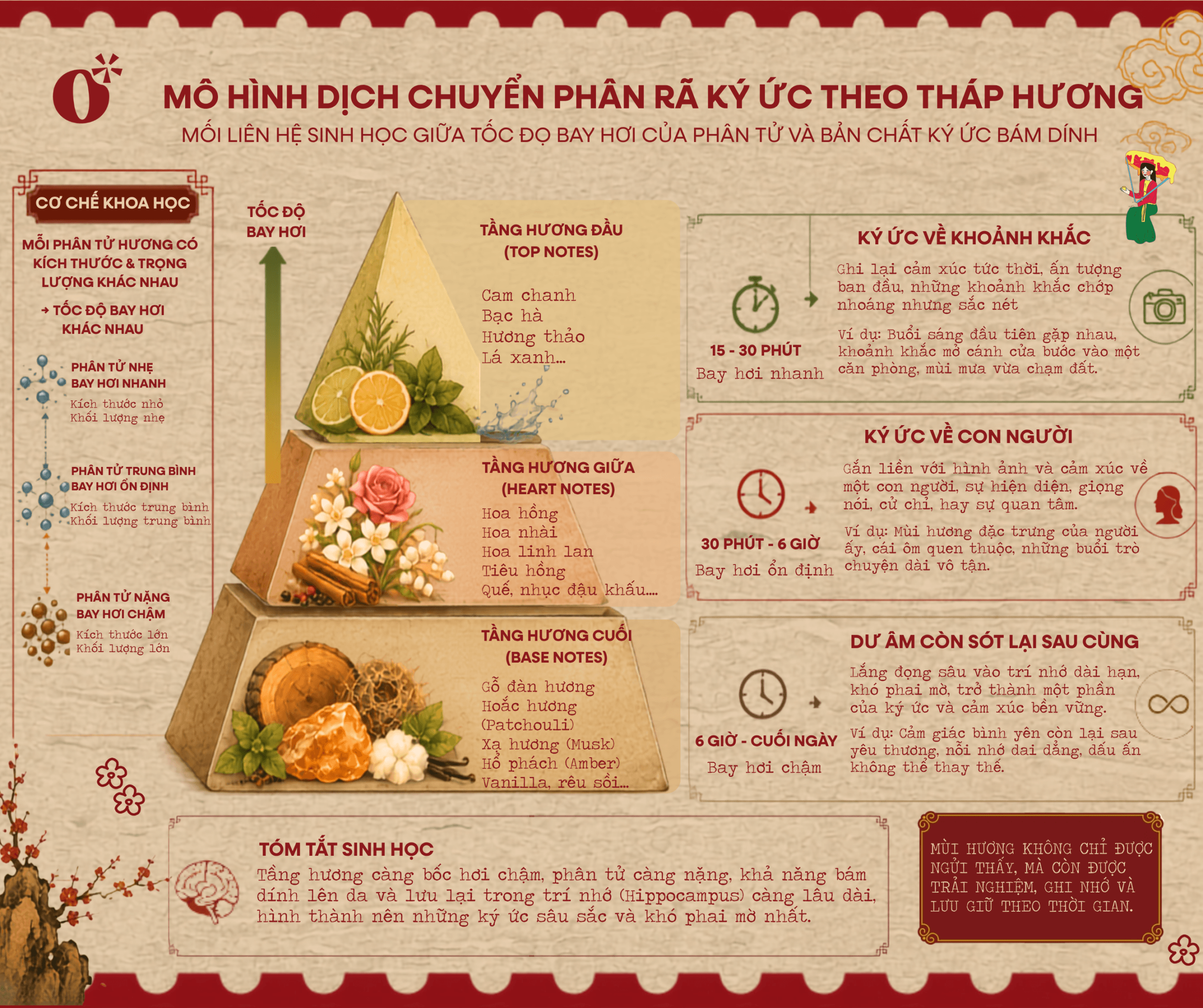
When a scent is deliberately tied to an act of communication or giving, the brain automatically packs the whole emotional state and spatial context of that relationship into the fragrance structure. Years later, when that scent returns, it works like a time machine, releasing the exact space and emotional state of the relationship at that milestone.
VI. WHEN A GIFT BECOMES A MEMORY OBJECT
Across many cultures, people keep memories in physical objects: a photograph, a handwritten letter, a keepsake. With scent, that keepsake becomes something more special — because the memory doesn’t live on paper or in a digital image, but is woken directly through the olfactory system each time the scent returns.
Thư Thơm (the Scented Letter)
- A memory-carrier that combines a linguistic anchor (handwriting) with an olfactory anchor (scent). The interweaving of personal handwriting and the oil particles clinging to the paper heightens its power to store and reactivate emotional memory in relationships.
When scent and a Scented Letter are paired with the ritual of giving, they become relationship memory artifacts for special occasions such as wedding, engagement or keepsake gifts.
Through a cultural lens, we designed four gift formats around this mechanism:
- Hồng Điều (the anchor of a blessing): using Hồng Điều paper — the red paper on which, in the old days, people wrote couplets and painted Tết pictures. It is a ritual of sending good wishes, binding heartfelt sentiment to an olfactory anchor.
- Tâm Giao (a shared memory between two people): a pair of scents for two, paired with a handwritten Scented Letter. What’s kept isn’t the physical liquid — it’s the memory of the moment the two of you open the gift together, read the words within and touch a scent you both know.
- Huyền Thanh & Yên Chi (a quiet note and an enduring presence): anchors that keep the sound of everyday love, or that stand for a relationship gentle and at peace through the years.
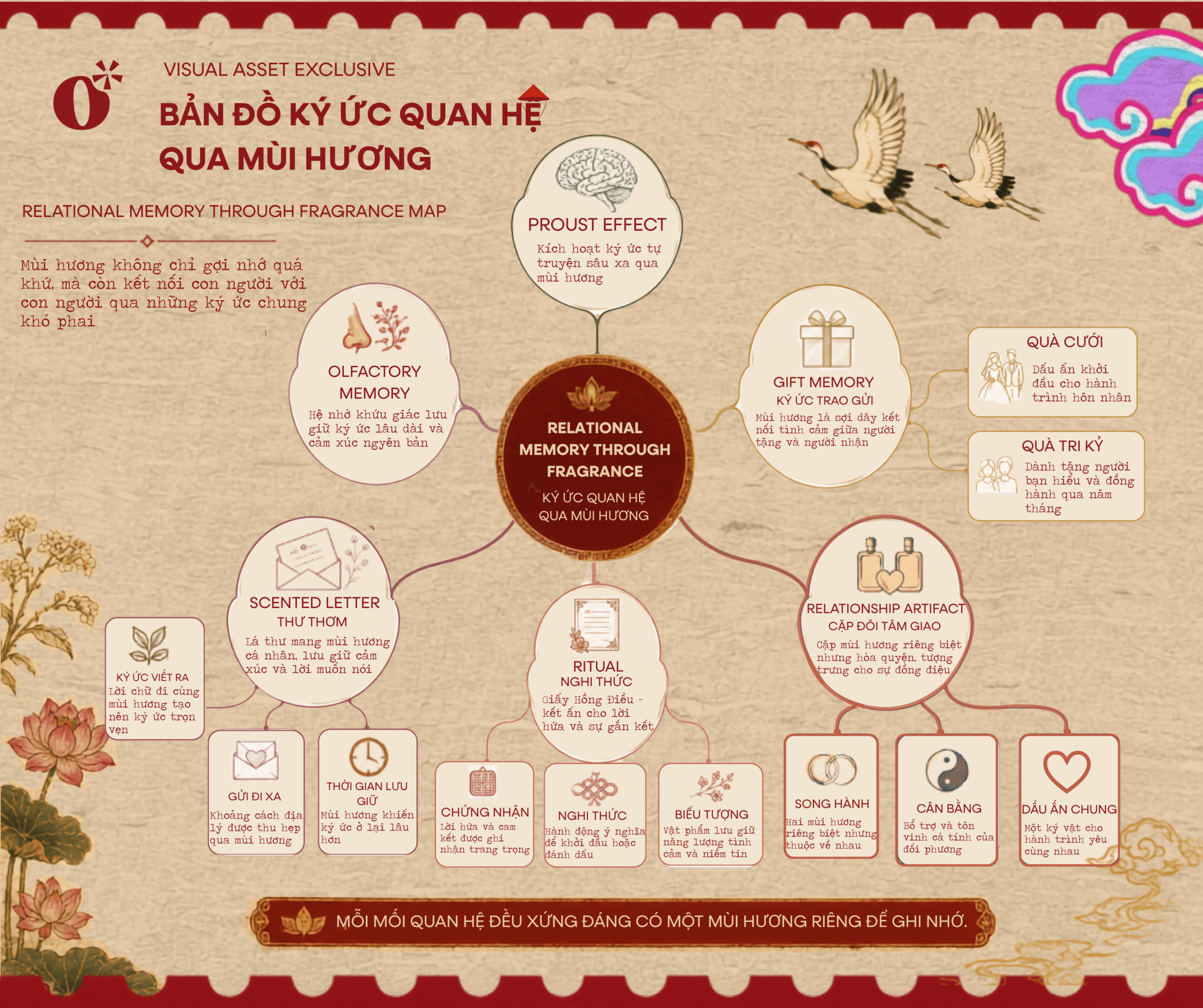
VII. FIELD NOTES FROM THƠMORE LAB: MEMORY THROUGH SCENT
Note: these are qualitative observations drawn from conversations and consultations recorded by Thơmore — not quantitative research representative of all perfume users.
We approach the theme of scent and memory through the lens of relational memory through fragrance. Across many conversations with customers, we’ve noticed three recurring patterns:
- Observation 1 — remembering the person: Most recipients tend to remember the image and feeling of the giver far more deeply than they analyse the note structure inside the bottle.
- Observation 2 — keeping the text: The share of people who deliberately keep a handwritten Scented Letter in a place of honour for a long time is higher than the lifespan of the perfume bottle itself.
- Observation 3 — olfactory durability: The oil particles clinging to the handmade paper of a Scented Letter can reactivate the original emotional state of a relationship even months later.
Frequently Asked Questions (FAQ)
- Why can a scent so deeply awaken the memory of someone from your past?
Because the olfactory pathway connects directly to the amygdala (which processes emotion) and the hippocampus (which stores autobiographical memory) before passing through the brain’s other processing centres. When you smell a familiar scent again, the original emotional state of the relationship tied to it wakes instantly.
- How can you use perfume to preserve the memory of a wedding or anniversary?
Tie the scent to a deliberate ritual. Choose a pair of scents neither of you has worn before, to wear only for that occasion. The brain will automatically bind the scent, the ritual and the person, packing the whole emotion of that moment into a relational memory.
- How does a Scented Letter help preserve affection?
A Scented Letter combines a textual anchor (a handwritten note about feelings) with an olfactory anchor (oils absorbed into the paper). This interweaving creates a powerful relationship memory artifact — letting the recipient touch both the writing and a scent they know by heart.
The information here is for reference. Scent and memory are highly subjective — the experience can vary with your skin chemistry, where you wear it and how each person perceives it.
About Thơmore
Thơmore is a Vietnamese perfume brand inspired by literature, developing scents that carry the spirit of memory, emotion and the cultural textures of everyday Vietnamese life.
Explore more at: thomore.vn/en
 Tiếp tục với Zalo