

 Tiếng Việt
Explore with Thomore
Why Do Some Perfumes Last Longer Than Others?

Jul
A Scientific Look at Fragrance Performance
Longevity is one of the first things people ask about when choosing a perfume. It is also where most of the myths live. Plenty of people believe that a more expensive perfume lasts longer, that EDP always outlasts EDT, or that niche fragrances automatically outperform designer ones. In reality, those factors account for only a small part of the story.
Quick Summary
- What it really is: Longevity is not decided by EDP, EDT, niche or designer. It is the result of the formula as a whole.
- The core factor: Substantivity describes how well aroma molecules cling to skin or fabric over time.
- Real-world performance: How long a scent lasts is shaped at the same time by molecular structure, note families, the wearer’s own body and the surrounding environment.
- In practice: A scent that suits your climate and your skin usually gives a steadier experience than one chosen purely for maximum longevity.

Looking for what to do about it rather than why it happens? See how to apply perfume so it lasts — seven practical rules on placement, moisturising, spray counts and tropical-climate effects.
I. Is Longevity Really Decided by Fragrance Concentration?
One of the most common misconceptions is that a higher EDP concentration means the perfume lasts longer.
In fact, concentration only tells you the ratio of aromatic oils to solvent. It says nothing about how those molecules behave once they meet your skin.
Two bottles both labelled Eau de Parfum can still give you very different wear times. A formula leaning on citrus or green-leaf compounds may disappear within a few hours, while one built on woods, resins or musks can hold on considerably longer.
What decides the outcome is not “what percentage of oil” but which molecules are making up that scent and what their physical properties are. Concentration is one factor. It is not the only one.
II. What Is Substantivity?
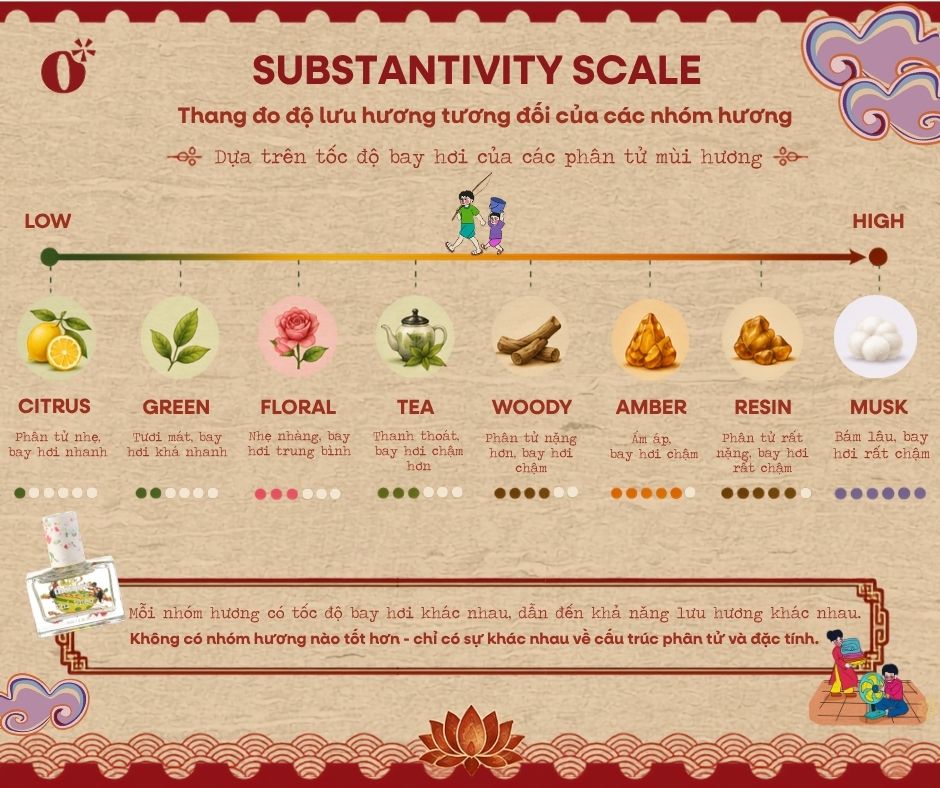
In fragrance science, substantivity is the term for how well an aroma molecule clings to a surface once it has diffused.
That surface might be human skin, fabric fibres, a paper blotter, or any other material used while evaluating a scent.
A simple way to picture it: some molecules behave like water vapour, spreading fast and vanishing just as quickly. Others behave more like tree resin or dry wood, needing far longer to evaporate completely. That difference is exactly why some scents seem to “stay” while others do not.
One thing worth keeping in mind: substantivity is not the same as quality. A scent that lasts six hours is not automatically better than one that lasts two. Many compositions are deliberately designed to feel bright and light and to accompany you for a set stretch of time — which was the point of them all along.
III. Why Does Each Note Family Hold On Differently?
Note families differ not only in how they smell, but in the physical properties of the molecules that make them up.
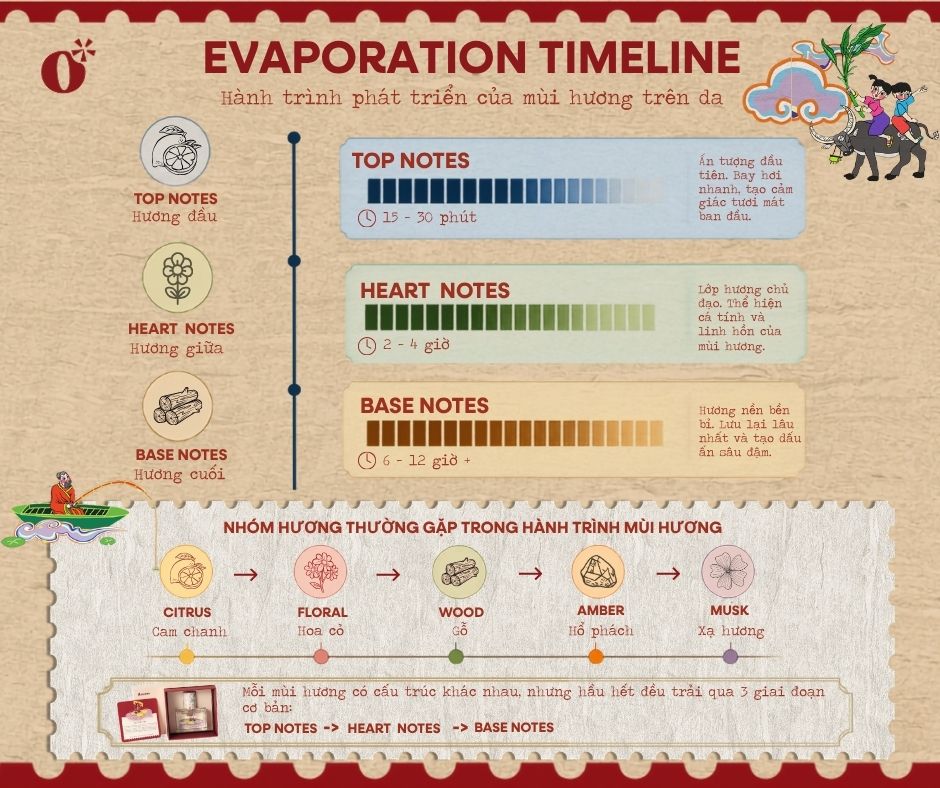
Citrus notes tend to be built from small compounds that evaporate quickly. That is why they feel so fresh the moment you spray — and why they are the first notes to go.
Woods, ambers, resins and musks, by contrast, have more stable molecular structures and diffuse more slowly. They usually serve as the base notes, stretching the experience out over time.
This is why two bottles at the same Eau de Parfum concentration can perform completely differently. Longevity reflects molecular structure far more than it reflects a brand’s market segment.
IV. Why Does the Same Bottle Last Differently on Different People?
If substantivity explains what the molecules are inherently capable of, the experience you actually get is shaped by something else as well: skin chemistry — the interaction between the formula and your own body.
No two skins are identical. Moisture levels, sebum, surface temperature, pH, even your daily routine can all change how aroma molecules diffuse and hold.
Drier skin, for example, tends to let molecules evaporate faster, because there is less natural lipid to hold them in place. Oilier skin can extend wear time, though it may also shift how certain notes read.
Environment matters just as much as body. Someone working in an air-conditioned office will experience a scent very differently from someone riding a motorbike outdoors in the heat. Wind, temperature and humidity are constantly acting on how fast the molecules diffuse, so the same bottle behaves differently from one situation to the next.
That is why “how many hours does this bottle last?” is such a hard question to answer precisely. Treat any stated wear time as a reference range: the real result is always a combination of the formula, your body and where you wear it.
V. Fragrance Performance in a Tropical Climate
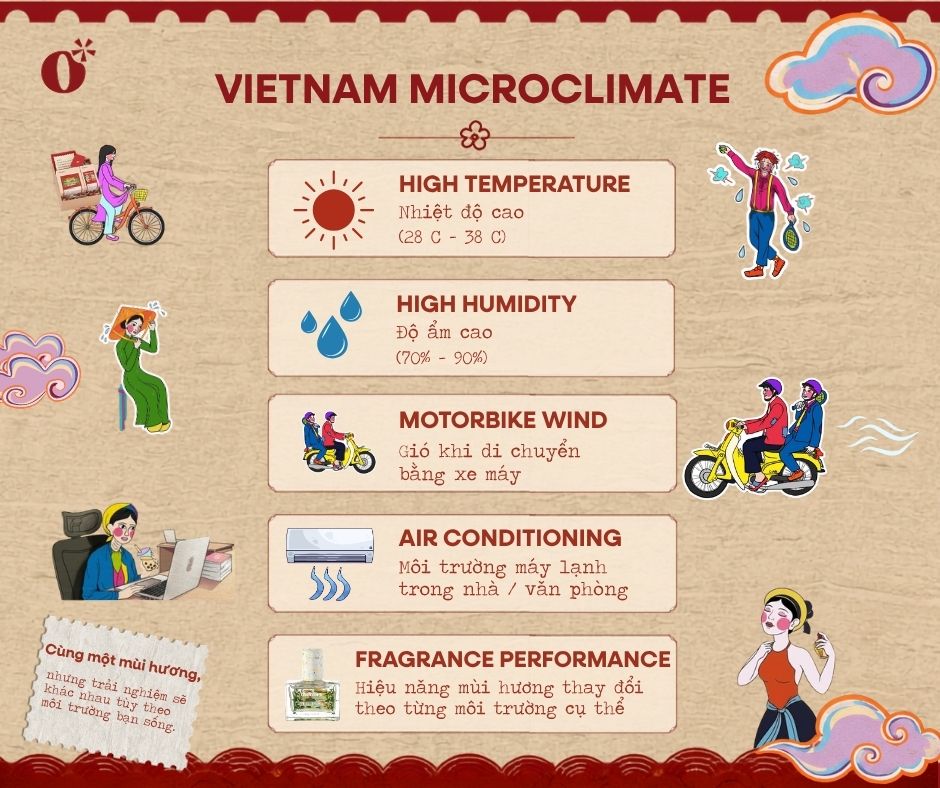
Most modern fragrance research and trends were formed in temperate countries. Vietnam, meanwhile, sits in a tropical monsoon zone: high temperatures, heavy humidity and strong solar radiation for most of the year.
That makes for an entirely different wearing context — one shared by much of Southeast Asia and by anyone living in a hot, humid climate.
Heat speeds up the evaporation of aroma molecules, especially top notes like citrus, green leaves and light herbs. Wind, if you are travelling by motorbike, strips those top notes away faster still. At the other extreme, long hours in air conditioning dehydrate the skin, which lowers its ability to hold scent at all.
In other words, a fragrance’s real performance is not settled in the laboratory. It is settled when the scent enters everyday life.
This is why a number of modern perfumers have started paying attention to climate adaptation — tuning a formula to suit the conditions of a particular climate zone. For tropical countries such as Vietnam, the choice of base structure, the pace at which the layers turn over, and the balance between projection and tenacity all need to be weighed against how the scent will really be worn.
For a deeper look at climate and choosing a fragrance that suits it, see: Perfume and the Tropical Climate: Choosing a Scent for Vietnamese Wearers
VI. Thơmore’s View on Fragrance Performance
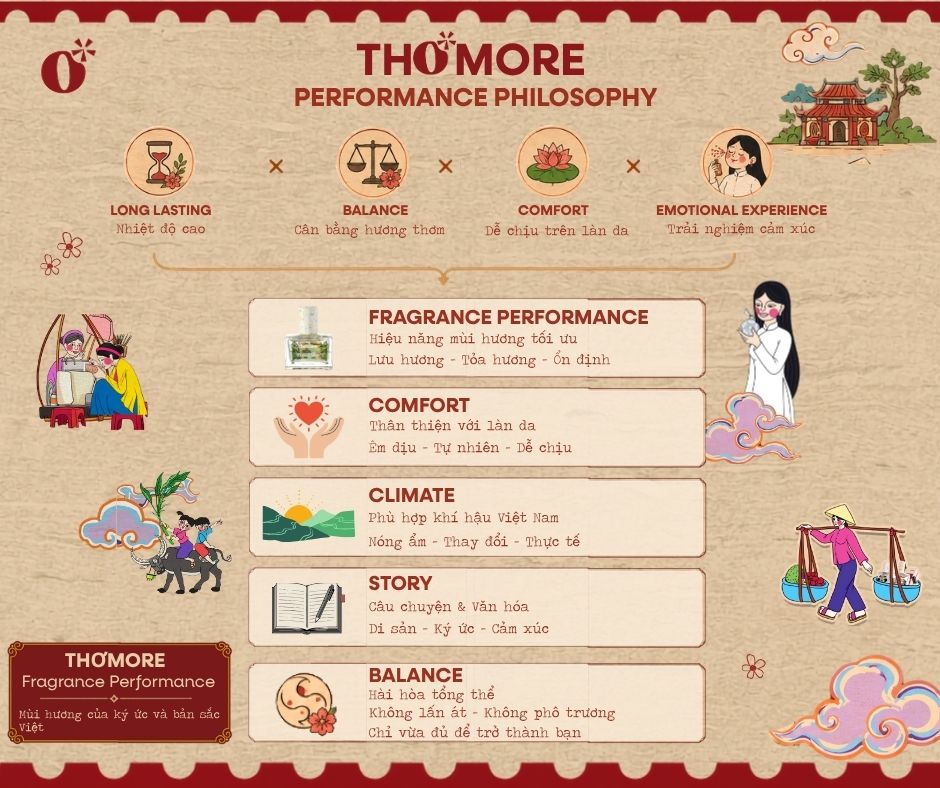
At Thơmore, we treat longevity as one part of overall performance, not as the single goal of a formula.
A scent can last a very long time, but if it loses the balance between its layers, or turns heavy in heat and humidity, the day-to-day experience will not necessarily be a pleasant one.
So when we develop a formula, several things are weighed at once: how naturally the layers transition, whether the scent keeps its identity in tropical conditions, how comfortable it feels in ordinary daily use, and how stable the base holds after several hours on skin.
For compositions drawn from Vietnamese literature, sustaining the emotional experience matters as much as sustaining the scent. A fragrance needs more than a long life — it needs to change at a natural pace, so it keeps the spirit of the story it set out to tell.
That is why, rather than chasing a number of hours, we build formulas with balanced performance: suited to the conditions they will actually be worn in, and consistent from the first spray until the last of the base settles.
VII. Frequently Asked Questions
1. Why do two Eau de Parfum bottles last different lengths of time?
Eau de Parfum concentration only reflects the ratio of oil to solvent. Longevity also depends on the substantivity of the aroma molecules, the structure of the formula, the note families involved and the conditions you wear it in.
2. What is substantivity?
Substantivity is the ability of aroma molecules to cling to skin or another surface once they have diffused. It is one of the key scientific factors behind how long a perfume lasts.
3. Does oily skin hold perfume longer than dry skin?
In many cases, the natural oil on skin does help aroma molecules stay put for longer. The result still varies with the individual formula and with each person’s body.
4. Does hot weather make perfume fade faster?
Yes. High temperatures speed up the evaporation of many aroma molecules, top notes most of all. Wind and humidity also affect how a scent diffuses and moves between its layers.
5. What should I look at if I want a perfume that lasts?
Rather than looking only at EDP or EDT, consider the scent structure as a whole, the note families, the climate you will wear it in and how well it suits your own skin. That gives a steadier experience.
This article is for reference. Your real experience of a scent can change with your skin, the environment you wear it in and how you personally perceive it.
About Thơmore
Thơmore is a Vietnamese perfume house inspired by literature, building scents out of memory, feeling and the cultural materials of everyday Vietnamese life. We approach perfume as a combination of the real compositional structure (actual notes) and a layer of cultural association (cultural imagery), to create scent experiences with depth that still sit close to ordinary life.
Explore more at: thomore.vn
 Tiếp tục với Zalo