

 Tiếng Việt
Explore with Thomore
Why Does a Perfume Have Multiple Note Layers?

Jul
A look at fragrance architecture
The first time they wear a perfume, many people notice the scent has changed after a few minutes, then keeps shifting hours later. To a newcomer this can seem like the perfume is “turning” or unstable. In fact, it’s one of the most important features of the perfumer’s art.
Quick Summary
- Architecture: A perfume isn’t built from a single smell but from several layers of scent that follow one another over time.
- Role: Top, heart and base notes aren’t a ranking of value; they create a complete journey of perception.
- Mechanism: A multi-layer architecture lets a scent change naturally on skin instead of staying the same from start to finish.
- In practice: Each layer plays its own role in the scent experience.
I. What is fragrance architecture?
A perfume isn’t designed to tell its whole story in a single moment. Instead, the perfumer builds a fragrance architecture of several transitioning layers, so the scent experience unfolds naturally over time.
Think of a scent like a meeting. You can’t understand a person from their first hello, just as you can’t take in a whole perfume in the few seconds after spraying.
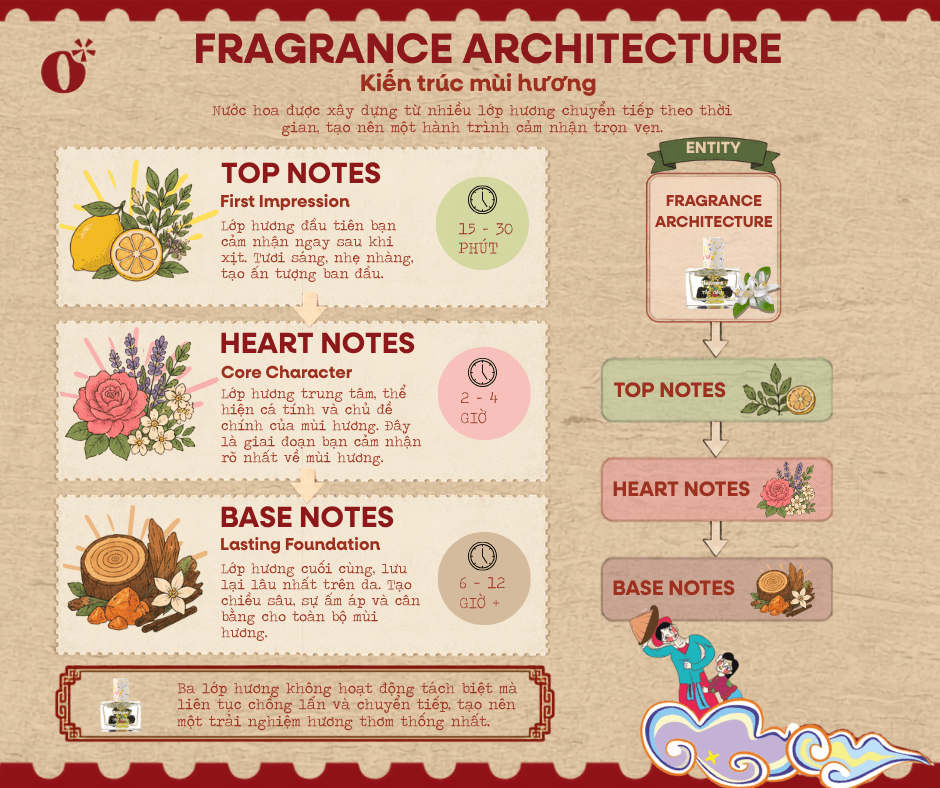
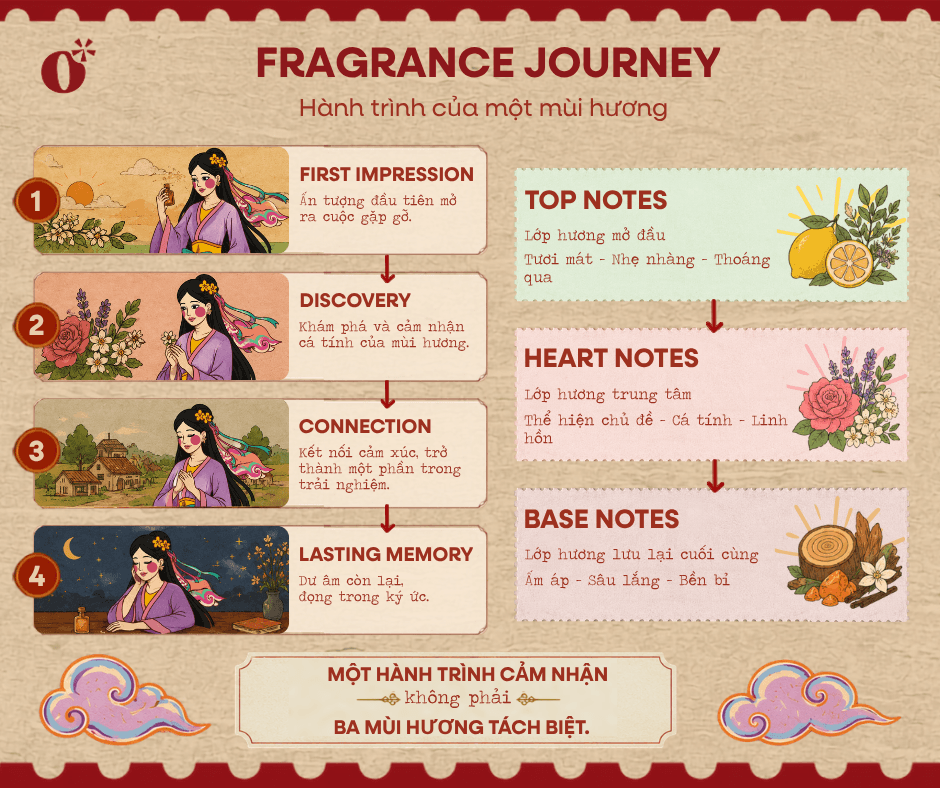
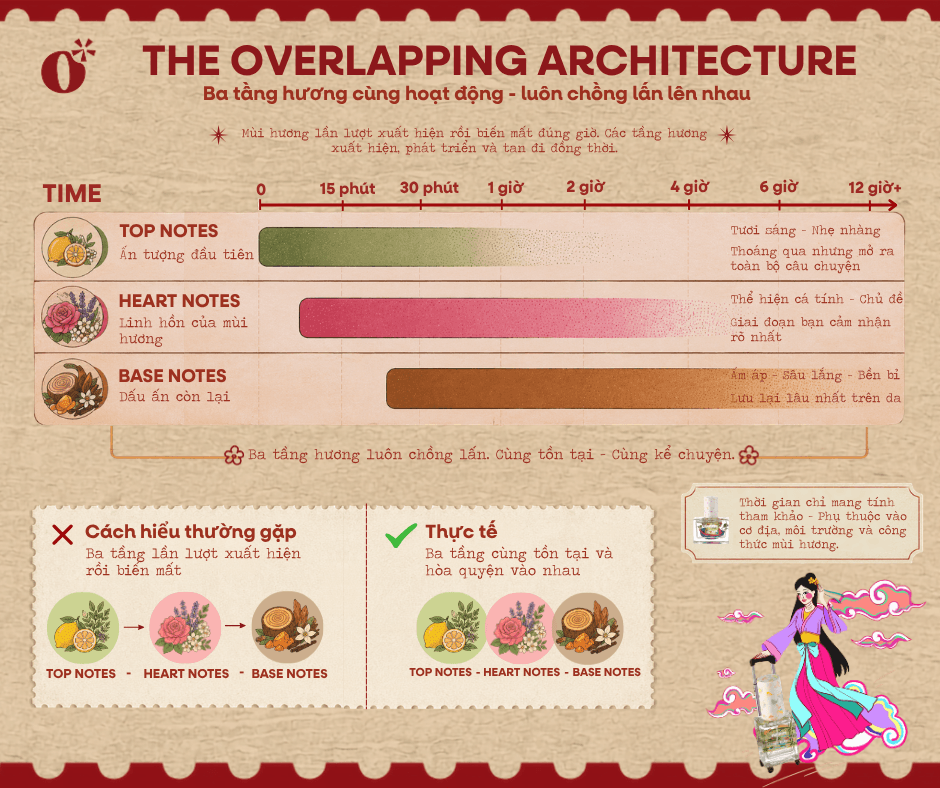
So most modern perfumes are built in three layers of experience: top notes (the opening), heart notes (the centre) and base notes (the layer that lingers last). These three don’t work in isolation but constantly overlap and transition, creating one unified experience.
II. Top notes — the first impression
Top notes are the layer you perceive right after spraying.
Their main role isn’t to represent the whole perfume, but to open the first conversation between the scent and the wearer.
The families that usually appear at the opening include citrus, green notes, fresh herbs and light spice. These bring a bright, easily recognisable feel and shape the first impression.
The key thing to remember is that top notes aren’t the perfume’s “main scent,” only the door that leads you into the whole experience.

III. Heart notes — the soul of the scent
As the top layer eases off, the heart notes begin to appear.
This is usually the stage that reveals the formula’s character most clearly. The heart is where the perfumer expresses the central theme of the creation — it might be florals, tea, spice, fruit or herbs.
If the top notes are the first hello, the heart notes are the real conversation. This is also the layer the wearer spends the most time experiencing.
IV. Base notes — the lasting impression
Base notes are the layer that appears last and lingers longest on skin.
Typically, this layer is built from warmer, deeper materials such as woods, amber, musk, resins or vetiver.
The role of the base isn’t just to extend the experience but to bring a sense of completeness and balance to the whole scent structure. It’s this foundation that gives the layers above a place to develop naturally.
V. Why doesn’t a perfumer choose just one scent?
If a perfume had one fixed smell from start to finish, the experience would be very monotonous.
A multi-layer architecture lets the scent develop over time, creating a sense of movement like a piece of music with an opening, a climax and an ending.
That’s why perfume is often likened to a time-based art: you don’t just smell a scent, you experience a journey.
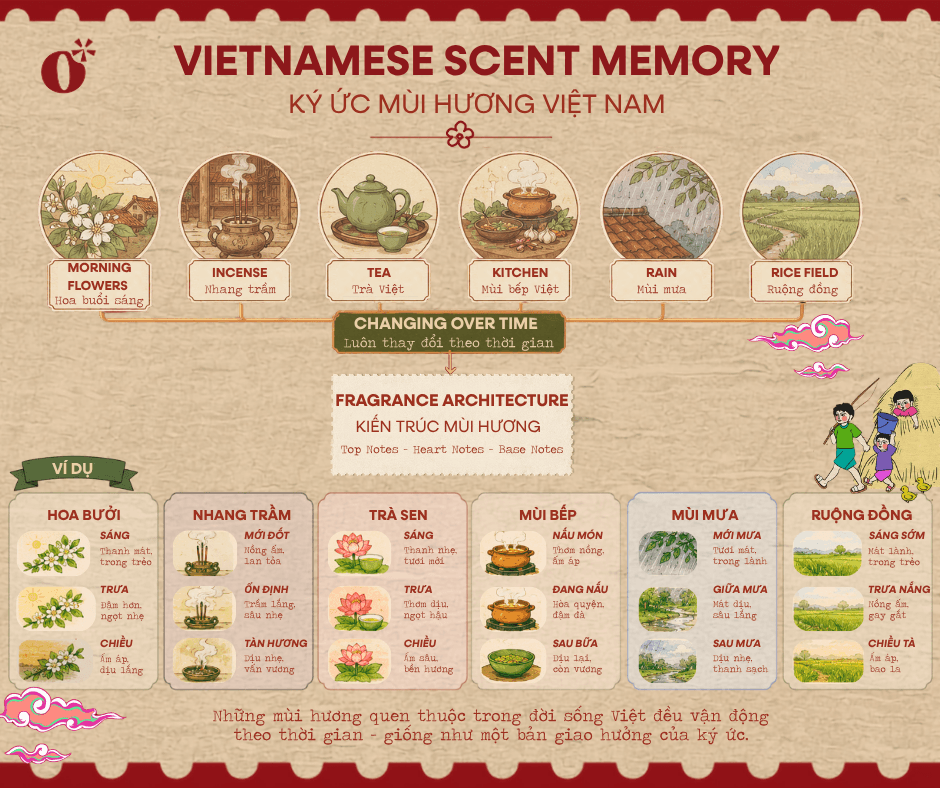
In fact, people had long been familiar with the way a scent moves over time, well before the idea of “three note layers” ever appeared. Agarwood incense smoke in an ancestral hall doesn’t rise as a single smell — it shifts from warm and rich when first lit to something deep and quiet as it burns down. Pomelo blossom is cool and clear in the early morning, and by midday under the sun grows fuller and warmer. It’s these quiet shifts that create an olfactory memory more enduring than any single note.
VI. Thơmore’s perspective
At Thơmore, we see top, heart and base notes not just as different layers of material, but as three chapters of the same story.
The opening creates an emotional space. The middle develops the central idea. The final layer leaves an echo in memory.
What we care about isn’t whether each layer stands out on its own, but whether the whole journey is seamless, natural and true to the spirit of the original story.
For creations inspired by Vietnamese literature, each layer helps retell a slice of the work, so the experience goes beyond enjoying a pleasant smell to evoking associations of memory, culture and life.
For a practical guide to what top, heart and base notes are, how long each typically lasts on skin and how to test a perfume by its notes, see top, heart and base notes explained.
Frequently Asked Questions (FAQ)
1. Are top notes the main scent of a perfume?
No. Top notes are only the first layer you perceive. A formula’s central theme is usually shown more clearly in the heart notes.
2. Why does a perfume’s smell change after a few minutes?
That’s the natural transition between the layers in the fragrance architecture — not a sign the perfume has gone off.
3. Does every perfume have all three layers?
Most modern perfumes are built on a multi-layer structure, though how distinctly the layers separate can vary with the perfumer’s creative intent.
4. Do top, heart and base notes decide longevity?
Not entirely. The role of the three layers is to create the architecture of the experience. Longevity depends on other factors such as the formula, the nature of the materials, your skin chemistry and where you wear it.
The information here is for reference. The real scent experience can vary with your skin chemistry, where you wear it and how each person perceives it.
About Thơmore
Thơmore is a Vietnamese perfume brand inspired by literature, developing scents that carry the spirit of memory, emotion and the cultural textures of everyday Vietnamese life.
Explore more at: thomore.vn/en
 Tiếp tục với Zalo