

 Tiếng Việt
Explore with Thomore
How to Decant Perfume at Home: 4 Methods That Work
Oct
Want to carry your favourite scent with you without lugging the full bottle around? Decanting perfume at home is not difficult once you know the process and have the right tools. This guide from Thơmore walks you through how to decant perfume at home properly, so the scent keeps its character and as little as possible evaporates along the way.
Quick Summary
- Four methods, each for a different situation: a refillable atomiser, an extension nozzle, a syringe, or spraying straight from the nozzle.
- The refillable atomiser is the most popular — convenient and loses the least scent; the extension nozzle suits bottles whose nozzle will not come off; the syringe is for splitting one bottle into equal portions or decanting in volume.
- Spraying straight from the nozzle wastes the most — no tools needed, but it scatters easily, so do it in a still room away from draughts.
- The decant bottle must be clean and dry first, and dark glass (brown or black) beats plastic, because plastic can absorb fragrance oils and distort the scent.
- How long the decant keeps comes down to storage: seal the cap tightly, keep it somewhere cool and dry away from sunlight and heat, do not open it repeatedly, and store it in a closed box or a drawer.
What you need before you start
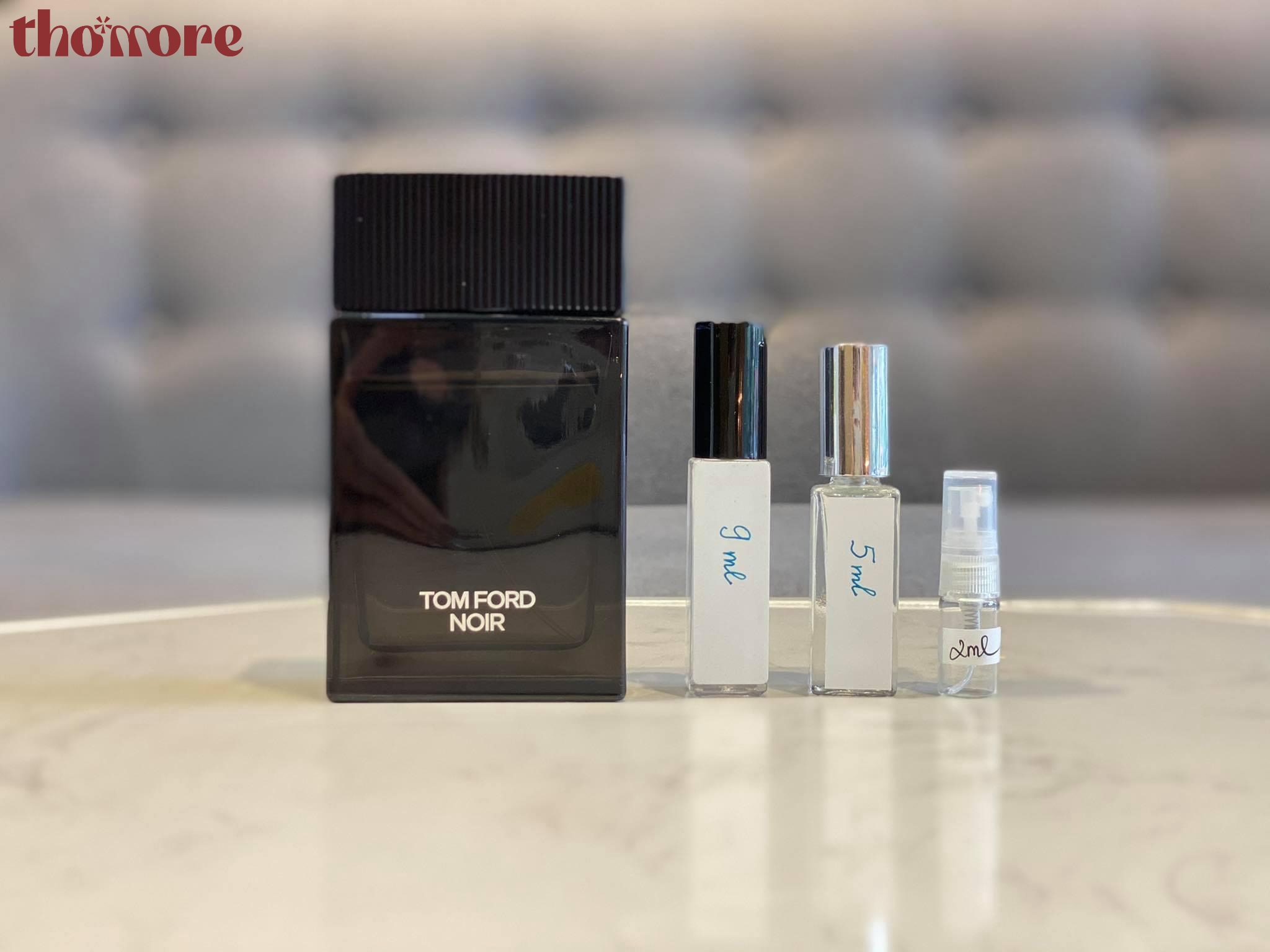
To move perfume from a large bottle into a small one safely and without damaging the fragrance, gather these basics:
- The original bottle
The bottle you want to decant from. Check that its cap and nozzle are intact and undamaged, so the transfer goes smoothly and little scent escapes.
- A mini decant bottle
- Common sizes: 5ml, 10ml or 20ml.
- Choose one with a screw cap or an airtight spray cap so the perfume keeps longer.
- Two types are widely available:
- Refillable atomiser: has a built-in pump, convenient, and you never have to open the cap.
- Plain decant bottle: screw-cap style, needs a separate tool to fill.
- Transfer tools
Depending on the method you pick, you may need:
- A syringe (needle removed): draws and pushes perfume precisely, with very little loss.
- An extension nozzle: for bottles with an unusual design, making the transfer easier.
- Tissue or gloves: keeps your grip firm so the bottle does not slip.
- A flat, clean surface: somewhere to rest everything while you work, for hygiene and safety.
How to decant perfume at home, step by step
Decanting lets you carry the scent you love without the full bottle. Below are four common methods, all easy to do and suited to different bottle designs.
1. Decanting with a refillable atomiser
The simplest method, and a favourite because it is convenient and loses very little scent.
Step 1: Prepare, and remove the nozzle from the original bottle
Gently pull the spray nozzle off the large bottle. Work carefully so you do not damage or bend the nozzle head, which would affect the transfer.
Step 2: Connect the atomiser to the original bottle
With the nozzle off, seat the base of the mini bottle onto the opening the nozzle came from. Getting this seated properly matters — a poor fit leaks and lets the perfume evaporate.
Step 3: Pump the perfume across
Press down firmly and evenly on the atomiser to pump perfume from the large bottle into the small one. Keep going until you reach the amount you want, or the decant is full.
Step 4: Finish and refit the original nozzle
Once done, lift the mini bottle off and refit the spray nozzle to the large bottle as it was. This protects the original bottle and stops the scent escaping.
Note: always make sure the decant bottle is clean and dry before you start, so the perfume keeps its original character.
2. Decanting with an extension nozzle
This method suits bottles with an unusual design whose nozzle is hard to remove, making the transfer safer and easier.
Step 1: Fit the extension nozzle to the large bottle
First remove the original spray nozzle and fit the extension nozzle in its place. A click means it is seated firmly and fully engaged.
Step 2: Place the extension nozzle into the decant bottle
Once fitted, guide the tip of the extension nozzle into the mouth of the mini bottle. Hold both bottles steady so nothing shifts mid-transfer.
Step 3: Transfer the perfume
Press gently and evenly on the nozzle so the perfume flows into the mini bottle. Stop when you reach the amount you want and check for leaks.
Step 4: Remove the extension and refit the original nozzle
Finally, take the extension nozzle off and refit the original spray nozzle to the large bottle. Make sure it seals properly so the fragrance does not evaporate.
Note: this method is precise and clean, but you need a firm grip so the perfume does not spray out.
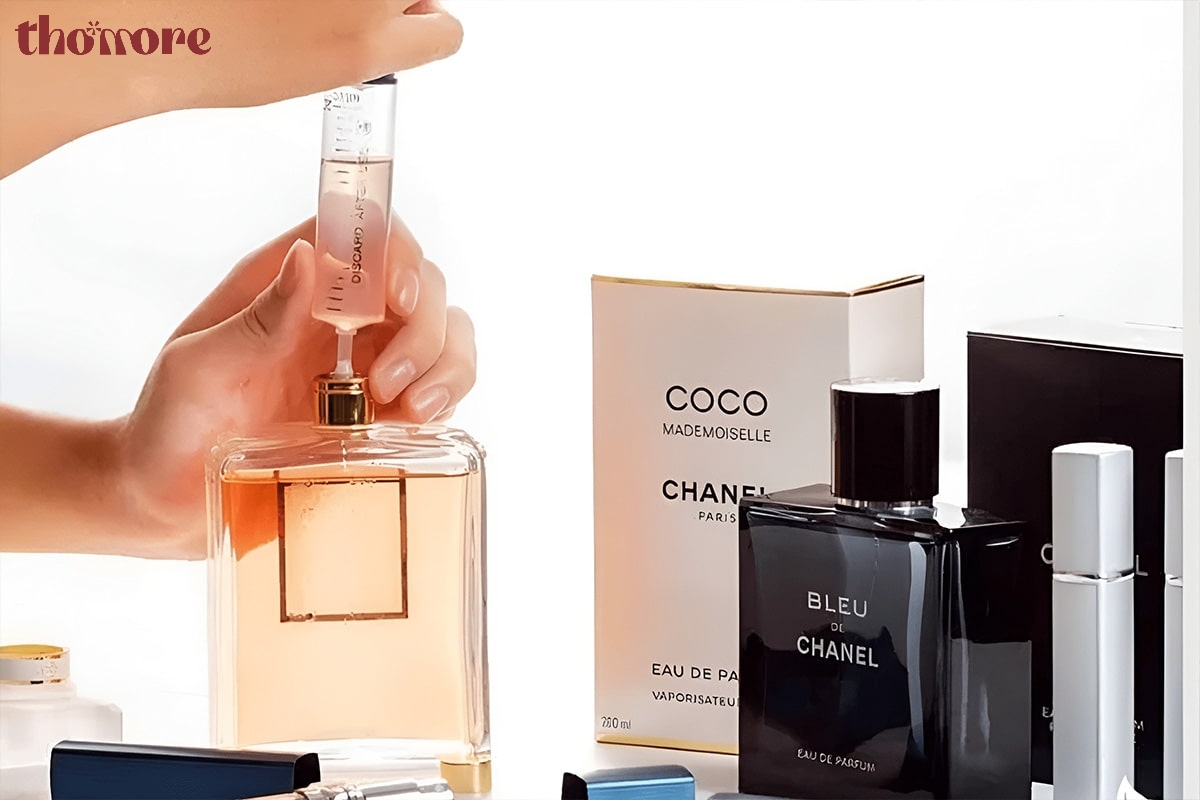
3. Decanting with a syringe
A syringe works well when you want to split perfume into equal portions, or decant a larger quantity at once. It gives you precise control over how much you take and limits loss during the transfer.
Step 1: Remove the cap and nozzle from the original bottle
Turn the cap and nozzle anticlockwise to lift them off. Go carefully — some nozzles are fitted quite tightly and can snap if you force them.
Step 2: Draw the perfume up with the syringe
Take a syringe (no needle) and place its tip into the opening the nozzle came from. Pull the plunger back slowly to draw the perfume up, keeping the syringe upright so no air gets in and the draw stays even.
Step 3: Push the perfume into the decant bottle
Once you have enough, put the syringe tip into the mouth of the decant bottle. Press the plunger gently and evenly so the perfume flows in without creating air bubbles, which waste product and can affect the scent.
Step 4: Refit the nozzle and store the original bottle
When the transfer is complete, refit the spray nozzle to the large bottle and close the cap tightly. This keeps the original perfume in better condition and preserves its scent.
Note: do not let air into the syringe — it wastes perfume and affects the quality of the fragrance.
>>> Browse other Thơmore perfumes
4. Decanting straight from the spray nozzle
This is the no-syringe method: simple and quick, and the one to use when you have no tools at all. It does take a steady hand to avoid spilling or wasting perfume.
Step 1: Hold the two bottles at a right angle
Grip the large bottle and the mini bottle firmly, and hold the spray nozzle at 90 degrees to the mouth of the decant bottle. The angle is what stops the spray going sideways or scattering.
Step 2: Spray into the decant bottle
With everything held steady, press evenly to spray perfume into the mini bottle. Working gently and slowly keeps the stream stable, so it neither overflows nor foams.
Step 3: Cap it and check
Once you have enough, close the cap immediately so the scent does not escape. Check the cap and the rim carefully to make sure the perfume is properly sealed in.
Note: this method is easy but wastes the most perfume, so do it in an enclosed space away from strong draughts.

Which method should you use? A side-by-side comparison
| Method | Best for | Tools needed | Main caveat |
|---|---|---|---|
| Refillable atomiser | Everyday use, bottles whose nozzle comes off | Refillable atomiser | The decant bottle must be clean and dry first |
| Extension nozzle | Unusual bottle designs, nozzle hard to remove | Extension nozzle | Precise and clean, but needs a firm grip or it sprays |
| Syringe | Splitting into equal portions, or larger volumes | Syringe | Tight nozzles can snap if you force them |
| Straight from the nozzle | When you have no tools at all | None | Wastes the most — work in a still room, away from draughts |
How to keep a decant from losing its scent
Once you have moved perfume into smaller bottles, storing it properly is what keeps the fragrance intact and slows evaporation. These simple habits make the difference:
- Keep it somewhere cool and dry: avoid direct sunlight or anywhere near a heat source, because high temperatures change the structure of the fragrance and shorten its longevity.
- Seal the cap tightly after decanting: once filled, make sure the cap is screwed down firmly. A turn of clear tape around the cap adds a little extra seal against evaporation.
- Choose the right decant bottle: favour dark glass such as brown or black to keep light from altering the scent. Avoid plastic, which can absorb fragrance oils and distort them.
- Do not keep opening the cap: every opening exposes the perfume to more air, which speeds up oxidation and scent loss.
- Store it in a box or a drawer: keeping the decant in a closed box or drawer limits its exposure to draughts and dust, and preserves the fragrance for longer.
Common mistakes when decanting perfume at home
Small details are easy to skip when decanting, yet they are exactly what affects the quality and longevity of the fragrance. Here are the mistakes worth avoiding:
- Using tools that are not clean: a syringe or decant bottle that has not been washed thoroughly can carry dust or old fragrance oils, which alter the scent and make it less pure.
- Decanting in a draught: working near a fan or in a strong breeze makes the perfume evaporate faster, wasting product and weakening the concentration.
- Not checking that the decant seals: if the cap does not fit snugly, the perfume evaporates or leaks in storage, wasting the product and lowering its quality.
- Using poor-quality plastic bottles: some plastics react with the alcohol or fragrance oils in perfume, changing the scent and making it turn faster.
- Decanting far more than you need: perfume decanted and then left unused oxidises more easily, and loses the character that made it worth carrying.
Decanting for air travel, and where personal use ends
The most common reason people decant is to take a scent travelling. One number matters here: the International Air Transport Association (IATA) states that liquids in carry-on baggage must be in containers of no more than 100 millilitres, packed in a clear, resealable bag. This is an aviation security rule and it applies to the original bottle as much as to a decant — so a 5–10ml decant always clears it.
There is also a separate limit on the total quantity of alcohol-based toiletries each passenger may carry, counted across both carry-on and checked baggage. The exact figures vary by airline, so for a long trip, or when carrying several bottles, checking with your airline first is the safe move.
One boundary worth stating plainly: decanting for your own use is a different matter from decanting to sell. In Vietnam, selling decanted perfume means placing a cosmetic product on the market, which brings a product-notification obligation under Circular 06/2011/TT-BYT — an organisation or individual may only place a cosmetic product on the market once it has been issued a product notification receipt number, and that number is valid for five years from the date of issue. Everything in this guide is written for personal use.
How to spot a good source for decant bottles
Buying decant bottles from a reliable seller protects the fragrance and saves you from leaks and evaporation. These are the signs of a source worth trusting:
- Clear product provenance
Reputable shops tell you exactly where the bottles come from, which brand made them or where they were manufactured. Where they can, they will show you photographs and import paperwork for transparency.
- A real range of designs and sizes
A professional supplier carries several shapes, colours and capacities (5ml, 10ml, 20ml and so on), so you can match the bottle to what you actually need — travelling, or giving as a gift.
- Transparent returns and warranty
A trustworthy seller accepts returns when a product is faulty, the nozzle fails or the bottle leaks. They usually make a clear commitment about product quality on delivery too.
- Genuine customer feedback
Favour shops with a good record on social media or marketplace platforms. Real reviews from previous buyers are the most reliable evidence you have against poor-quality goods.
Thơmore does not sell decants, but we do offer a number of 10ml minis — small enough to carry, and an easy way to try a scent before committing. Despite the size, they hold exactly the same quality and character as the full-size bottle, which suits anyone who likes to move between several fragrances.
Done properly, decanting perfume at home saves you money, protects the fragrance and makes it far easier to carry. Choose a good decant bottle, work carefully, and store it somewhere cool — the scent will stay as it should. With the steps and habits in this guide, you can decant at home with confidence.
Related reading:
- How to choose a men’s perfume that matches your style and personality
- What is a signature scent, and how do you find yours?
Frequently Asked Questions
1. Which decanting method wastes the least perfume?
The refillable atomiser and the extension nozzle lose the least, because the perfume travels straight from the original bottle into the small one with almost no contact with the air. Spraying directly from the nozzle wastes the most, since the spray scatters easily.
2. What if the bottle’s nozzle will not come off?
Use an extension nozzle. It exists for exactly that situation — bottles with an unusual design whose original nozzle is hard to remove. A click tells you it is seated firmly; then guide the tip into the decant bottle and press evenly.
3. Should a decant bottle be glass or plastic?
Choose dark glass, brown or black, because the dark colour keeps light from altering the scent. Avoid plastic, which can absorb fragrance oils and distort the fragrance over time.
4. Can you take a perfume decant on a plane?
Yes, and this is the most common reason people decant in the first place. IATA requires liquids in carry-on baggage to be in containers of no more than 100 millilitres, packed in a clear resealable bag — so a 5–10ml decant always qualifies. There is also a limit on the total quantity of alcohol-based toiletries per passenger, so on a long trip it is worth checking with your airline.
5. Do you need paperwork to sell decanted perfume?
Yes, and this is where it differs sharply from decanting for yourself. Selling a decant means placing a cosmetic product on the market, which in Vietnam requires product notification under Circular 06/2011/TT-BYT: a cosmetic product may only be placed on the market once a product notification receipt number has been issued, and that number is valid for five years from the date of issue.
 Tiếp tục với Zalo