

 Tiếng Việt
Explore with Thomore
Perfume Concentration Explained: Parfum, EDP, EDT, EDC & Eau Fraiche
Jul
When you choose a perfume, the scent isn’t the only thing that matters — its concentration does too. Concentration directly shapes how long a fragrance lasts, how strong it smells and the overall experience of wearing it. This guide from Thomore explains what concentration is, how the common types differ, how to pick the right one for your needs, and clears up the myths people repeat about it.
Quick Summary
- Concentration is the ratio of aromatic oils to solvent (mainly alcohol and water). The higher the ratio, the stronger, more projecting and longer-lasting the scent tends to be.
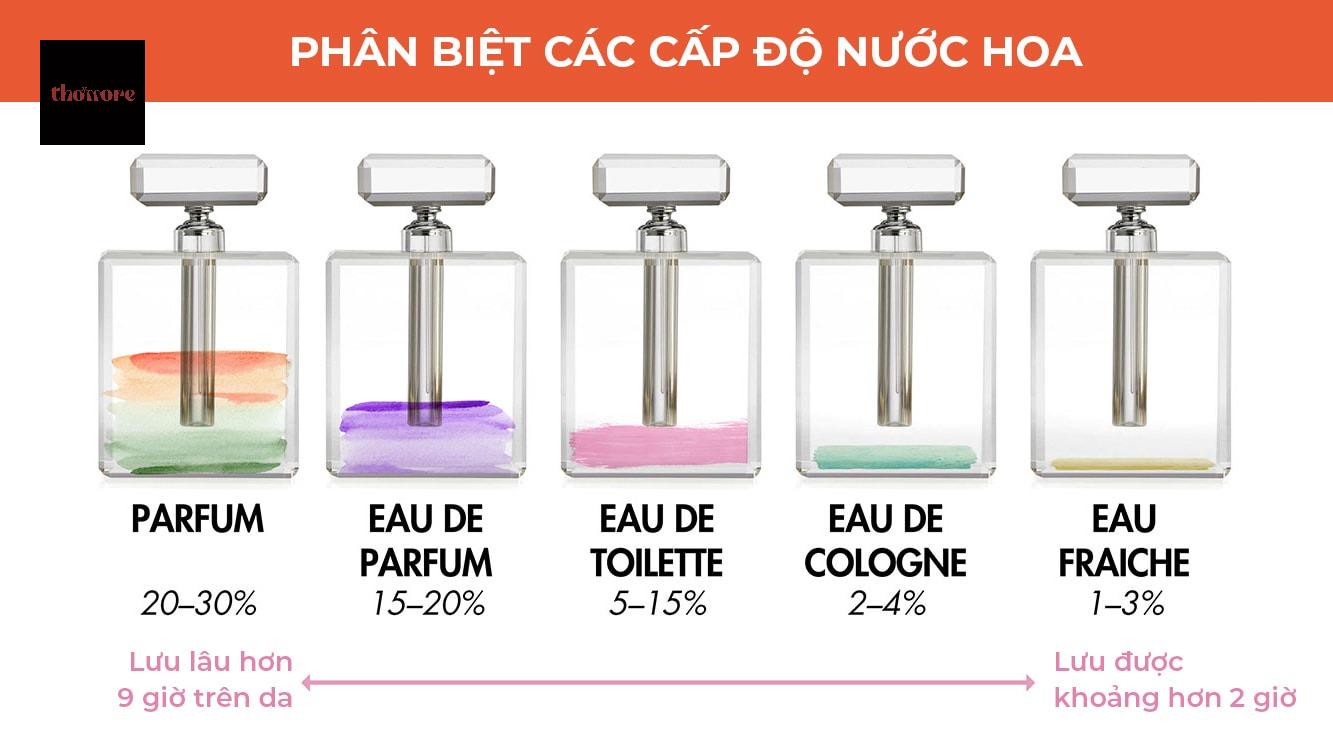
- Five common levels: Parfum (20–30%, some up to 40%), EDP (15–20%), EDT (5–15%), EDC (3–8%), Eau Fraîche (under 3%).
- Higher concentration usually lasts longer, but it doesn’t decide everything — whether a scent reads as heavy or soft depends on the formula, the raw materials and how the notes are blended, not just the percentage.
- Choose by need: EDP for all-day wear or evenings; EDT/EDC for hot days, the office, or when you like to reapply through the day.
What is perfume concentration?
Perfume concentration is the percentage ratio between aromatic oils (the scent molecules) and the solvent (mainly alcohol and water) in a bottle of perfume. The higher this ratio, the more intense, far-reaching and long-lasting the scent is on skin. It’s the key factor that distinguishes one class of perfume from another.
Many people assume perfume is 100% pure essence, but it’s actually a controlled blend of aromatic compounds and a base solvent. Alcohol doesn’t just help the scent diffuse better — it also preserves the volatile oils, keeping the fragrance stable and helping it hold on the skin.
Common types of perfume concentration
On the market today, concentrations vary widely to suit different needs and wearing styles. Understanding what sets each one apart helps you pick a scent that fits the moment. Here’s an overview of the concentrations you’ll come across most often.
Parfum (20–30%)
This is the highest oil concentration available. With aromatic oils ranging from 20% to 30% — and some special formulas reaching 40% — parfum delivers a dense, luxurious scent that clings to the skin for a very long time. It also goes by names such as “extrait de parfum” or “pure perfume,” and is usually applied in small amounts for all-day effect.
Key strengths:
- Long wear, typically 8–12 hours and up to 24 depending on your skin and the weather.
- Economical, since a small amount is enough to carry the scent all day.
- Low alcohol content, gentler on the skin and well suited to dry or sensitive skin.
>>> Browse more perfumes from Thomore
Eau de Parfum (15–20%)
EDP is one of the most popular and best-loved concentrations today, with oils ranging from 15% to 20%. It’s a natural pick for events, dates or outdoor occasions because it’s expressive without being harsh. In practice, many brands favour EDP because it strikes a good balance between quality, performance and price.
Key strengths:
- Long wear of 6–10 hours, fine for a full workday or a night out.
- Diffuses gently within close range.
- Moderately rich, rarely sharp or overpowering.
- More affordable than parfum while still feeling refined.
- Suits both newcomers and people with a clear taste in fragrance.
Eau de Toilette (5–15%)
Eau de Toilette (EDT) has a long history and was once part of the daily grooming ritual of the aristocracy. With oils of 5% to 15%, EDT sits in the lighter, easy-to-wear category that fits many settings.
Key strengths:
- Light, airy and easy to like.
- Well suited to hot climates and the office.
- Average wear of 3–6 hours, depending on your skin.
- Affordable and accessible.
- A popular everyday choice that flatters most wearers.
Eau de Cologne (3–8%)
EDC is a low-concentration perfume, usually just 3% to 8% oils, giving a fresh, relaxing feel from the first seconds. With its light citrus opening and short cling, cologne is commonly worn as a scent you refresh several times a day.
Key strengths:
- Ideal for reapplying through the day without becoming heavy.
- Instantly refreshing and invigorating on application.
- Quick to revive you after exercise or at the end of the day.
- Affordable, easy to find and often sold in larger bottles.
- Pairs easily with body-care products like shower gels and body mists.
Eau Fraîche (<3%)
Eau Fraîche has an extremely low oil concentration, usually under 3%, and is mostly water. Thanks to its soft scent and unstuffy feel, it gives an instant cooling, refreshing sensation. Its wear is very short, though — often under an hour — so it’s used more as a refreshing spritz than a proper perfume.
Key strengths
- Extremely gentle, almost never irritating.
- Delivers a quick freshness, great after activity.
- A mild option for sensitive skin and younger wearers.
- Can be reapplied often without becoming overpowering.
- Low cost, suited to frequent, easygoing use.
How to choose the right perfume concentration
When buying perfume, the first thing to look for is a scent you genuinely love. Beyond that, choosing the right concentration matters too, because it affects how well the scent holds and how it feels to wear.
If you like a rich scent that lasts all day, Eau de Parfum (EDP) is the ideal choice. If you have sensitive skin or prefer something lighter, consider Eau de Toilette (EDT) — popular, easy to wear and never too strong.
Eau de Cologne (EDC), with its lower concentration, suits everyday wear, especially in the heat or after a workout. Its fresh, airy scent leaves you feeling comfortable and confident.
Does concentration change the scent itself?
Yes. Every perfume is built in three layers: top, middle (heart) and base notes. But how soon each layer appears and how long it lasts differs with concentration.
In lower-concentration types like Eau de Toilette, the top notes tend to evaporate within about 15–20 minutes, the heart is faint and the base lingers only a few hours. Eau de Parfum, being more concentrated, lets the layers blend more smoothly for a richer, longer-lasting effect.
Parfum — the highest concentration — can present all three layers clearly at once, creating depth and holding for the whole day. So understanding concentration helps you match a perfume to your taste, your needs and the occasion.
Common myths about perfume concentration
Concentration strongly influences how a scent projects and lasts on the skin. Not everyone reads it correctly, though. Here are a few common misconceptions:
- Higher concentration means a heavier smell: In reality, concentration only tells you how much oil is in the perfume; whether it smells heavy or pleasant depends on the formula, the materials and the blending.
- Low-concentration perfume never lasts: Some Eau de Toilettes still hold well if they suit your skin and the weather.
- Only Eau de Parfum is worth buying: Each concentration has its own strengths; Eau de Cologne, for instance, is perfect for summer or the office thanks to its light, fresh scent.
Understanding perfume concentration doesn’t just help you pick a long-lasting scent that fits the occasion — it lets you enjoy the full emotion a fragrance can carry. Each concentration has its own character and merits. Choose the one that suits your personality, your environment and how you want others to experience you.
Why do two bottles both marked “EDP” smell so different in strength?
Here’s what surprises many people: the names Parfum, EDP, EDT and EDC are not defined by any law. Neither the EU Cosmetics Regulation — (EC) 1223/2009 — nor US cosmetics law specifies a minimum oil percentage for each type, or how an EDP must differ from an EDT. These are industry conventions, not legal thresholds.
As a result, the concentration ranges overlap and every perfumer interprets them their own way. A formula with 14% oils might be sold by one house as a “strong EDT” and by another as a “light EDP” — the call is largely commercial. The proof is right there in the classification tables: this article lists EDC at 3–8%, while another source puts it at 2–5%. There is no absolute “correct” figure.
What does this mean when you buy perfume? Don’t rely on the letters EDP/EDT on the bottle to judge strength or longevity. One brand’s EDT can easily be richer and longer-lasting than another brand’s EDP. The surest way is still to test on your skin and feel how it actually wears.
A note: the fragrance industry’s IFRA Standards govern the safety limits of individual ingredients, not concentration names — so those are two different things.
Frequently Asked Questions (FAQ)
1. Is EDP always stronger than EDT?
Not necessarily. Concentration names aren’t standardised by law, the percentage ranges overlap, and each brand sets its own — so one house’s EDT can be richer than another house’s EDP. Test on your skin rather than trusting the label.
2. Which concentration lasts the longest?
Parfum (20–30%, some up to 40%) usually lasts longest, roughly 8–12 hours and sometimes up to 24, depending on your skin and the weather. Actual longevity still depends on the formula and your individual skin.
3. Does higher concentration irritate skin more easily?
Not really. Parfum has a high oil ratio but low alcohol content, so it’s often gentler on dry or sensitive skin. Irritation depends on the specific ingredients, not just the concentration number.
4. Which concentration should a beginner choose?
EDP balances richness, longevity and price, making it a good fit for most beginners. If you prefer something light and easy for daily wear in hot weather, EDT will suit you better.
 Tiếp tục với Zalo