

 Tiếng Việt
Explore with Thomore
Sandalwood in Perfume: Scent, Origin and Why It’s So Prized
Jul
In the world of scent, sandalwood holds a special place for its warmth, soft sweetness and depth. It’s not just a common perfume ingredient but a symbol of refinement and staying power. This article helps you understand this distinctive note — its origin and character, and the standout Thomore fragrances built on sandalwood.
Quick Summary
- Sandalwood gives a warm, creamy, lightly sweet and very long-lasting scent — a woody note, but far softer than cedar or vetiver.
- The scent lives in the heartwood and roots, not the leaves or bark, so the tree must be old enough for the oil to reach quality.
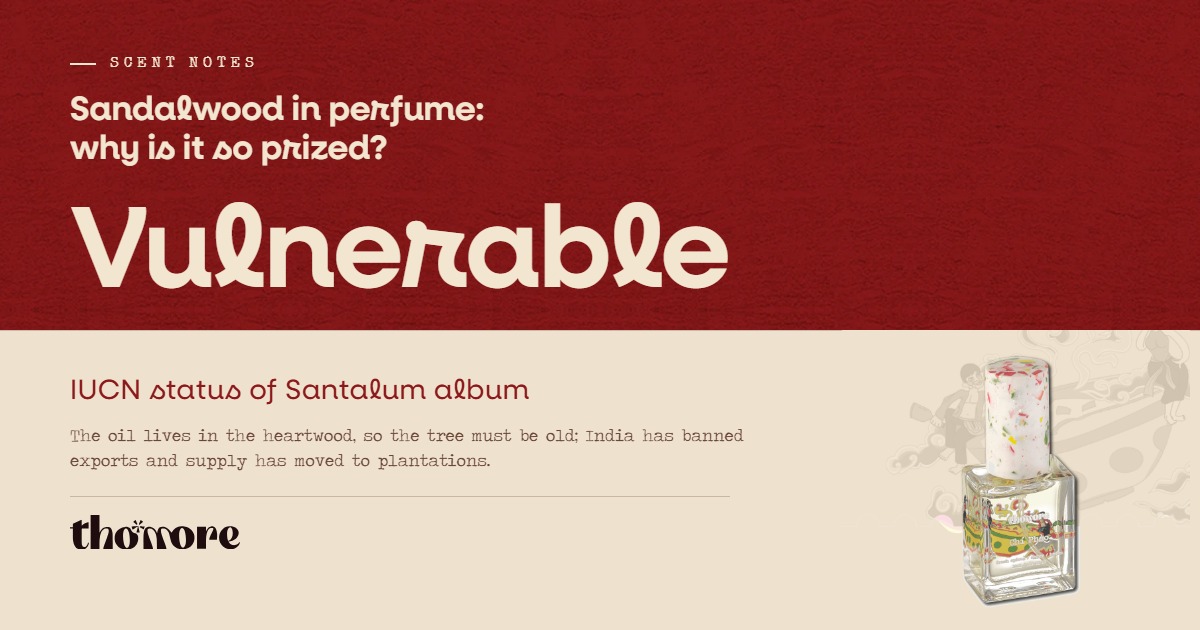
- It’s one of the most expensive materials in perfumery. Santalum album is listed as Vulnerable by the IUCN, India has banned exports, and supply has shifted to plantations in Australia.
- Its role in a formula is to anchor. Sandalwood holds a scent for a long time and smooths the notes above it, so it usually sits in the base.
An introduction to sandalwood
Sandalwood is one of the most beloved materials in perfumery, especially in Oriental-leaning fragrances. When people ask what sandalwood smells like, they usually picture something sweet and warm, with a light creamy richness, a gentle spice and a refined balsamic touch.
This scent isn’t sharp; it diffuses gently, bringing a relaxed, comforting feel. That’s why sandalwood appears not only in bold men’s fragrances but is also loved in women’s perfumes for its sensual, seductive depth.

The origin and harvesting of sandalwood
If you’re curious about the journey behind sandalwood’s distinctive scent in perfume, here’s a look at the origin and harvesting of this precious material.
Origin
Sandalwood belongs to the Santalaceae family and grows well in dry, hot terrain. Among the regions that cultivate it, India, Indonesia and Australia are seen as the three with the most consistent yields and finest quality.
In India, sandalwood — known as Chandan — is bound up with culture, faith and traditional medicine. Wood from trees over 40 years old tends to have a deep, rich scent and is highly sought after. Indonesia has its Kayu Cendana variety with a distinctive scent, while Australia is known for Australian Sandalwood, prized for its longevity and widely used in perfume and cosmetics.
How sandalwood is harvested
Harvesting sandalwood takes patience and careful technique. A tree needs at least 30 years to develop the heartwood that holds the aromatic oil — the factor that decides material quality.
Once mature, the tree is harvested for its core, where the oil is richest. This wood is then used to extract precious material for perfume, cosmetics, therapy or ritual. Because it grows slowly and is so valuable, sandalwood has been over-harvested in the past, leaving many areas depleted.

The character of sandalwood in perfume
In perfume, sandalwood is a classic base note — warm, soft and full of depth. Its scent carries a light creamy sweetness, laced with a warm spiciness and a passing balsamic touch, at once comforting and seductive.
Perfumes with sandalwood tend to last, leaving a deep impression on the skin. Paired with bergamot, lavender or geranium, it turns fresh and approachable. Blended with vanilla, clove or musk, it becomes far warmer, more sensual and more magnetic.
The benefits and effects of sandalwood
Beyond its warm, striking scent, a sandalwood perfume offers benefits for mood and experience:
- A relaxing feel: The soft, creamy scent with its balsamic touch calms the mind, eases stress and brings a sense of ease.
- Depth and luxury: The warm woody note makes a perfume feel refined and high-end, leaving a lasting mark.
- Balancing the scent structure: In a formula, sandalwood connects the note layers, letting the scent transition smoothly and pleasantly.
- Expressing character and style: A sandalwood perfume feels grounded and composed, well suited to people with refined, self-assured taste.
- Use in aromatherapy: Beyond perfume, sandalwood is used in therapeutic oils to relax and lift the mood.

Thomore fragrances featuring sandalwood
If you’re after a sandalwood perfume with a refined, deep style that wins you over from the first spray, Thomore’s fragrances are worth a look. Here are three that feature sandalwood in their note pyramid.
Bánh Trôi Nước
“Bánh Trôi Nước” — named after Hồ Xuân Hương’s poem “Bánh trôi nước” (Floating Sweet Dumplings) — is a fragrance in a modern East Asian spirit, evoking a woman who is resilient yet soft and graceful. It opens light and fresh, then gradually turns warm and profound, much like the timeless beauty of the poem it shares its name with.
Notes:
- Top: greenery, raspberry, pear, grapefruit
- Heart: violet, lychee, apple blossom, rose, jasmine
- Base: musk, sandalwood, plum
Longevity: 8–12 hours, depending on your skin
Sillage: within about a 2 m radius
For: those who love elegant, deep beauty; genderless, ideal for anyone who likes a sensual yet discreet scent with depth.

Đây Thôn Vĩ Dạ
One passing trace of scent, and memory floods back — soft as morning mist, lingering like early light on areca leaves. “Đây Thôn Vĩ Dạ” — after Hàn Mặc Tử’s poem — recalls things long gone yet never faded, an old memory quietly coming back to life in every breath, in every step home to somewhere familiar.
Notes:
- Top: Sambac jasmine, May rose
- Heart: mimosa, Australian laurel leaf, raspberry
- Base: sandalwood, musk, vanilla
Longevity: 8–12 hours, depending on your skin
Sillage: within about a 2 m radius
For: sensitive souls who have travelled far yet always carry a piece of the past in their heart. For those who love refinement, nostalgia and depth in a scent, regardless of gender.

Thu Điếu
No words are needed — some scents are enough to still the heart. “Thu Điếu” — after Nguyễn Khuyến’s poem “Autumn Fishing” — opens like a quiet autumn scene where floral and woody notes weave together, a sense of calm amid a restless world. Each layer is a slow breath, carrying you through fatigue and back to a still, poetic self.
Notes:
- Top: osmanthus, peach, orange blossom, bergamot, tangerine, cinnamon
- Heart: tuberose, jasmine, narcissus, May rose
- Base: sandalwood, cedar, amber, vetiver, patchouli
Longevity: 8–12 hours, depending on your skin and how it’s worn
Sillage: within about a 2 m radius
For: souls in need of healing, anyone seeking inner quiet, regardless of gender. Suited to cool weather, moments alone or thoughtful early mornings.

Tips for wearing sandalwood
Sandalwood in perfume brings a composed, seductive, refined feel. To wear it well without it turning heavy or unpleasant, keep these points in mind:
- Don’t overspray — this is a long-lasting base note that can become heavy if overdone.
- Favour cold seasons, evenings or enclosed spaces to draw out its full warmth and depth.
- Avoid layering too many products from the same family — body lotion, mist and a sandalwood perfume together can make the scent heavy and unbalanced.
- Give it about 30 minutes for the base to develop fully; only then does sandalwood truly reveal its signature scent.
Sandalwood is not merely a note but a trigger for emotion — bringing relaxation, luxury and depth. With its flexibility alongside many other families, sandalwood is a wonderful choice for anyone who loves refinement and longevity. Pick a perfume that suits you and take in the full beauty of this celebrated scent.
Why is sandalwood getting more expensive?
Sandalwood isn’t costly because it’s fashionable, but for three reasons that add up.
The tree has to be old enough
The oil concentrates in the heartwood and roots, and only reaches quality once the tree has matured over many years. There’s no shortcut — this is a material measured in decades, not seasons.
The natural source has declined
Indian sandalwood (Santalum album) is listed as Vulnerable on the IUCN Red List, due to over-harvesting and smuggling. India has imposed an export ban to protect the species.
Supply has shifted
A striking consequence: India — once the source of the world’s finest sandalwood — is now a net importer, buying oil from plantations in Australia to serve its domestic market.
What does this mean when you choose a perfume? A bottle labelled “sandalwood” at an everyday price almost certainly uses aroma materials that recreate the sandalwood scent, not pure sandalwood oil. That isn’t dishonest — with real oil, the bottle would sit in an entirely different price bracket. Recreated materials also ease the pressure on a declining species.
Frequently Asked Questions (FAQ)
1. If a perfume lists sandalwood, does it use real sandalwood oil?
Not necessarily. Natural sandalwood oil is very expensive and limited in supply, so most perfumes at everyday prices use aroma materials that recreate the sandalwood scent. This is common and legitimate industry practice.
2. Why does sandalwood last longer than many other scents?
Because the molecules that make up the sandalwood scent evaporate slowly. They sit in the base notes, lingering on skin and providing a foundation for the lighter notes above.
3. How do sandalwood and cedar differ?
Both are woody notes but feel completely different. Sandalwood is soft, sweet and creamy; cedar is dry, sharp and reminiscent of a pencil or freshly cut timber.
4. Why is sandalwood so expensive?
Three factors combine: the tree must mature for many years before the oil reaches quality, Santalum album is listed as Vulnerable by the IUCN due to over-harvesting, and India has banned exports — shifting global supply to plantations in Australia.
 Tiếp tục với Zalo